Key details for this exam, checked against the published exam outline
Each question shows the correct answer and an explanation of why it is right
Refer to the exhibit.
Which SD-WAN rule and interface uses FortiGate to steer the traffic from the LAN subnet 10.0.1.0/24 to the corporate server 10.2.5.254?
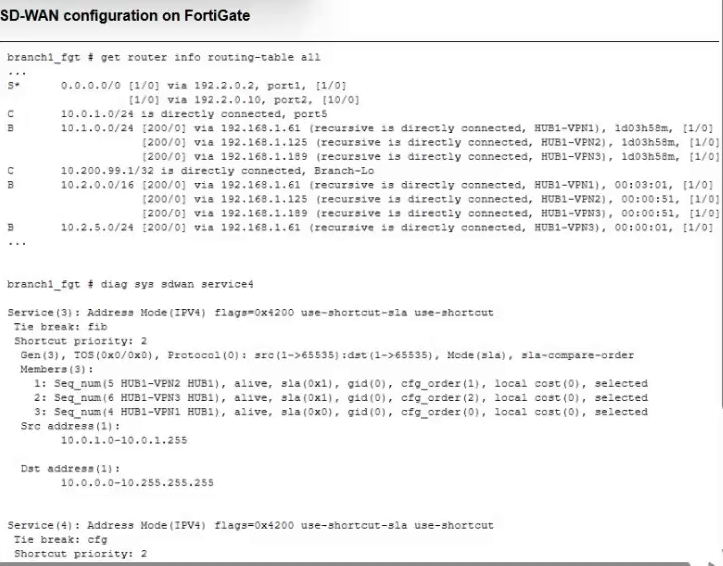
Exhibit --- SD-WAN rule and routing outputs
FortiGate SD-WAN traffic steering depends on both service-rule matching and routing-table reachability. A matching SD-WAN rule identifies eligible interfaces, but the selected member must also have a usable route toward the destination.
Option A is correct because service rule 3 matches the specified source and destination address ranges, and the routing table identifies HUB1-VPN3 as the route toward the corporate server subnet.
The source address 10.0.1.0/24 falls within the source range 10.0.0.0/8, while destination 10.2.5.254 also falls within the configured destination range.
The exhibit identifies service rule 3 as an SLA-based service with multiple available overlay members. However, the route to 10.2.5.0/24 identifies HUB1-VPN3 as the reachable next-hop interface.
Although HUB1-VPN2 appears in the service's eligible member list, it does not provide the matching destination route shown in the routing table. Therefore, option B is incorrect.
Options C and D reference service rule 4 and physical WAN interfaces. They do not represent the selected corporate overlay path for the stated source and destination.
This demonstrates a fundamental SD-WAN behavior: matching a service rule does not eliminate the requirement for valid route resolution through its forwarding member.
Refer to the exhibit that shows a diagnose output on FortiGate. Based on the output shown in the exhibit, what can you say about the device role and how it handles health checks?
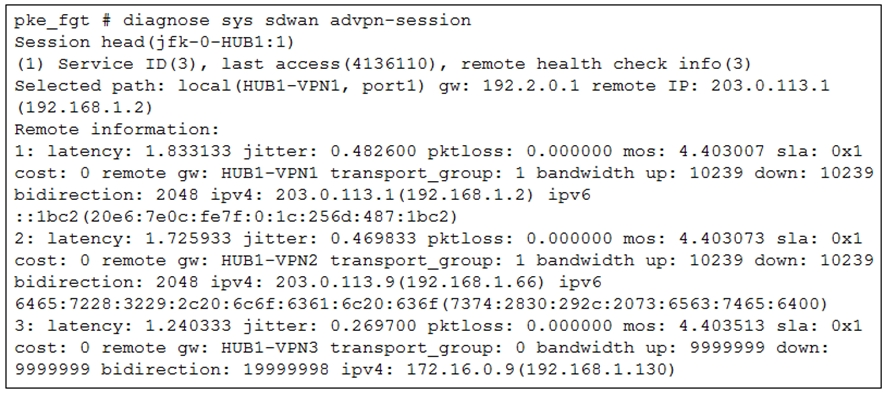
Exhibit 1
The diagnose sys sdwan advpn-session output shows remote health check info(3) and a selected local path such as HUB1-VPN1. It describes health-check information received by the local spoke from another spoke as part of ADVPN 2.0 edge discovery. The remote records can include bandwidth, latency, jitter, packet loss, transport group and SLA state. This information enables the local spoke to evaluate candidate direct shortcuts using both endpoints' path conditions. The output does not show a hub providing embedded measurements to a spoke and does not by itself indicate ongoing ICMP-based embedded SLA redistribution. The candidate key incorrectly describes the local spoke as the transmitter of the shown measurements. Reference: FortiOS 7.6 --- ADVPN 2.0 Edge Discovery and Path Management. FortiManager templates reduce repetitive work but must resolve to valid, device-specific configurations at installation time. Device assignments, metadata mappings, ADOM scope, policy-package interfaces and provisioning order should be inspected together rather than troubleshooting any one object in isolation.
Refer to the exhibit. Which statement best describe the role of the ADVPN device in handling traffic?
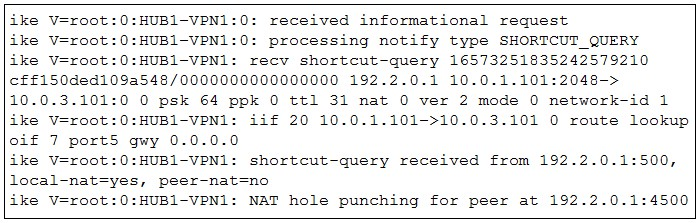
Exhibit 1
The IKE debug shows a receiving SHORTCUT_QUERY event and NAT hole punching, without an explicit forward shortcut-query record. This is consistent with a spoke receiving the shortcut-discovery query relayed by its hub over the existing spoke-to-hub tunnel. A hub-forwarder log would ordinarily include forwarding messages; the exhibit does not prove that a final spoke-to-spoke shortcut is already established. NAT hole punching is part of preparing connectivity when at least one endpoint is behind address translation, not proof that two established peers have completed negotiation. Therefore, the supported role is the destination spoke receiving a query via its hub. Reference: FortiOS 7.6 --- ADVPN Shortcut Discovery and NAT Traversal. An operational review should distinguish the rule that matches the traffic from the interface that is ultimately selected. Valid forwarding also depends on destination route eligibility, current member state and the applicable SLA or quality-selection algorithm. A diagnostic showing configured members alone is not conclusive evidence that all those members will carry a particular flow.
Refer to the exhibit. The administrator configured two SD-WAN rules to load balance traffic. Which interfaces does FortiGate use to steer the traffic from 10.0.1.124 to 10.0.0.254? Choose one answer.
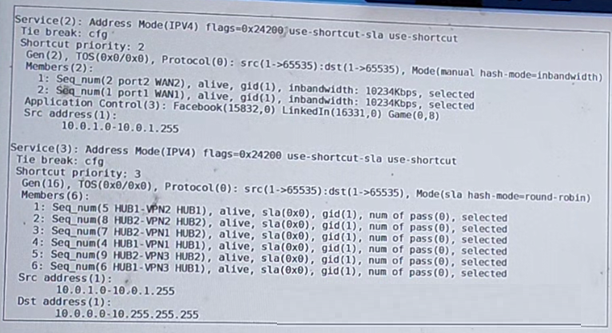
Exhibit 1
The destination matches the corporate SD-WAN service configured in Lowest Cost (SLA) mode. Its diagnostic listing marks six overlay interfaces alive and selected, but shows sla(0x0) and num of pass(0) for all of them. Under the default minimum SLA member behavior, FortiOS may fall back to operational out-of-SLA paths rather than automatically bypassing the service. Thus a blanket conclusion that FortiGate must route only according to the FIB is not supported by this diagnostic alone. All six selected overlays are candidate paths, subject to routing reachability and member-cost rules. Reference: FortiOS 7.6 --- Lowest Cost (SLA) and minimum-sla-meet-members. An operational review should distinguish the rule that matches the traffic from the interface that is ultimately selected. Valid forwarding also depends on destination route eligibility, current member state and the applicable SLA or quality-selection algorithm. A diagnostic showing configured members alone is not conclusive evidence that all those members will carry a particular flow.
Verification qualification: Six selected out-of-SLA entries do not by themselves prove that every interface will be used for this destination. Reference: https://docs.fortinet.com/document/fortigate/7.6.0/cli-reference/838040159/config-system-sdwan; https://docs.fortinet.com/document/fortigate/7.6.0/administration-guide/25967/equal-cost-multi-path
In which order does FortiGate consider the following elements during the route lookup process? Choose one answer.
In FortiOS (including FortiOS 7.6), FortiGate follows a strict and well-defined route lookup order when determining how to forward traffic. This order is critical for understanding SD-WAN behavior and is explicitly referenced in the FCSS SD-WAN curriculum. The correct lookup sequence is: Among the options provided, only Option D correctly reflects the beginning of this sequence by placing policy routes first, followed by ISDB routes, then SD-WAN rules, and finally static routes (representing the routing table). Therefore, the correct answer is D. An operational review should distinguish the rule that matches the traffic from the interface that is ultimately selected. Valid forwarding also depends on destination route eligibility, current member state and the applicable SLA or quality-selection algorithm. A diagnostic showing configured members alone is not conclusive evidence that all those members will carry a particular flow. When troubleshooting, correlate the configured SD-WAN service with diagnose sys sdwan service4, the live session entry and the routing table. An application signature, an IP route and a health-check result describe different decision stages; treating them as interchangeable can produce incorrect conclusions about the egress interface.
What is the benefit of branch on-ramp deployment with FortiSASE? (Choose one answer.)
According to the FortiSASE 25 Enterprise Administrator Study Guide, page 25, branch on-ramp deployment enables organizations to secure outbound internet traffic from branch locations by connecting their existing network infrastructure to FortiSASE.
Option A is correct: Branch on-ramp allows remote offices and branch locations to establish secure IPsec VPN tunnels between their FortiGate or supported third-party network devices and FortiSASE points of presence (PoPs). Traffic is forwarded through these tunnels, allowing FortiSASE to deliver cloud-based security inspection and enforcement.
The study guide explains that connected branches can benefit from Secure Internet Access (SIA), Secure SaaS Access (SSA), and Secure Private Access (SPA).
Option B is incorrect: Although branch on-ramp supports secure private application access, providing access through a bookmark portal is not its primary deployment benefit.
Option C is incorrect: Branch on-ramp provides secure network connectivity and traffic inspection. It is not designed primarily for endpoint inventory, administration, or lifecycle management.
Option D is incorrect: The study guide explicitly states that FortiClient installation is not required for branch edge-device deployments and that ZTNA tags are not supported in this configuration.
Therefore, branch on-ramp primarily enables organizations to extend FortiSASE cloud security services to branch offices and secure their internet-bound traffic.
Exact Source Reference:
FortiSASE 25 Enterprise Administrator Study Guide, page 25 --- Thick Edge Use Case, including secure branch outbound traffic and branch on-ramp.
FortiSASE 25 Enterprise Administrator Study Guide, page 26 --- FortiSASE Branch On-Ramp Configuration.
FortiSASE 25 Enterprise Administrator Study Guide, page 27 --- Edge-Device Policies, explaining the lack of ZTNA tag support.
Exam domains verified against: Official Fortinet NSE7_SSE_AR-26 exam guide, last checked October 2026.
You will design enterprise SD-WAN architectures that fit your organization's needs. The work includes deploying SD-WAN infrastructure across your network and implementing performance controls to manage traffic effectively.
Sample question from this domain above: Q2
Creating SD-WAN rules and configuring SD-WAN routing are core skills you need. You will also deploy advanced IPsec for SD-WAN to secure traffic between sites and remote users.
Evaluating FortiSASE components in advanced deployment scenarios helps you understand how they work in complex environments. You must integrate FortiSASE into hybrid networks and combine SD-WAN and FortiSASE workflows to support your security strategy.
Sample question from this domain above: Q3
Deploying FortiSASE access and onboarding gets users connected securely. You will configure endpoint posture and access control to verify devices meet security standards, and deploy cloud-delivered secure services to protect users and data.
Sample question from this domain above: Q6
Managing FortiSASE and SD-WAN deployments from a central location gives you control across your network. You analyze traffic and security logs to understand what is happening, then troubleshoot connectivity and policy behavior when issues arise.
Common questions about the exam itself

