Key details for this exam, checked against the published exam outline
Each question shows the correct answer and an explanation of why it is right
Refer to the exhibit.
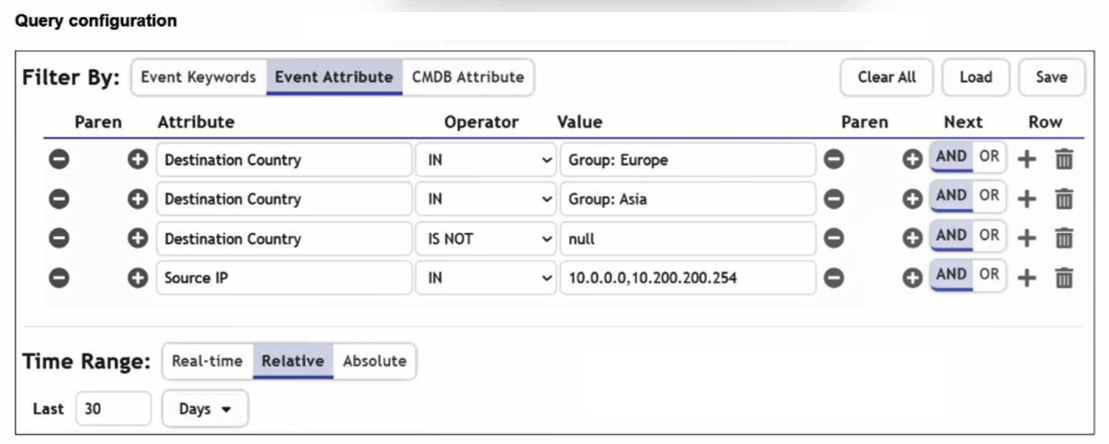
You are trying to find traffic flows to destinations that are in Europe or Asia, for hosts in the local LAN segment. However, the query returns no results. Assume these logs exist on FortiSIEM.
Which three mistakes can you see in the query shown in the exhibit? (Choose three answers)
Comprehensive and Detailed Explanation From FortiSOAR 7.6., FortiSIEM 7.3 Exact Extract study guide:
Analyzing the Query Configuration exhibit in the context of FortiSIEM 7.3 search logic reveals several syntax and logical errors that prevent the query from returning results:
Logical Operator Error (E): The user intends to find traffic to Europe OR Asia. In the exhibit, the first row (Group: Europe) is followed by a default AND operator. This forces the query to look for a single flow where the destination is simultaneously in Europe and Asia, which is logically impossible. It must be changed to OR.
Missing Parentheses (C): When combining OR and AND logic in FortiSIEM, parentheses are required to define the order of operations. Without them, the query might evaluate 'Asia AND Destination Country IS NOT null AND Source IP IN...' first. To correctly find (Europe OR Asia) that also matches the LAN segment, parentheses must group the first two rows.
Incorrect Operator for IP Range (D): The exhibit uses the IN operator for the value 10.0.0.0, 10.200.200.254. In FortiSIEM, the IN operator is used for a comma-separated list of specific values or CMDB groups. To specify a continuous range of IP addresses (the 'LAN segment'), the BETWEEN operator must be used.
Why other options are incorrect:
IS NOT null (A): In FortiSIEM, 'IS NOT null' is a valid operator/value combination used to ensure a specific attribute has been successfully parsed and populated in the event record.
Time Range (B): There is no requirement for a time range to be 'Absolute' when using CMDB groups; 'Relative' time ranges (like the 'Last 30 Days' shown) are commonly used and fully supported for such queries.
SOC Concepts and Frameworks
Which three end user logs does FortiAnalyzer use to identify possible IOC compromised hosts? (Choose three.)
Overview of Indicators of Compromise (IoCs): Indicators of Compromise (IoCs) are pieces of evidence that suggest a system may have been compromised. These can include unusual network traffic patterns, the presence of known malicious files, or other suspicious activities.
FortiAnalyzer's Role: FortiAnalyzer aggregates logs from various Fortinet devices to provide comprehensive visibility and analysis of network events. It uses these logs to identify potential IoCs and compromised hosts.
Relevant Log Types:
DNS Filter Logs:
DNS requests are a common vector for malware communication. Analyzing DNS filter logs helps in identifying suspicious domain queries, which can indicate malware attempting to communicate with command and control (C2) servers.
IPS Logs:
Intrusion Prevention System (IPS) logs detect and block exploit attempts and malicious activities. These logs are critical for identifying compromised hosts based on detected intrusion attempts or behaviors matching known attack patterns.
Web Filter Logs:
Web filtering logs monitor and control access to web content. These logs can reveal access to malicious websites, download of malware, or other web-based threats, indicating a compromised host.
Why Not Other Log Types:
Email Filter Logs:
While important for detecting phishing and email-based threats, they are not as directly indicative of compromised hosts as DNS, IPS, and Web filter logs.
Application Filter Logs:
These logs control application usage but are less likely to directly indicate compromised hosts compared to the selected logs.
Detailed Process:
Step 1: FortiAnalyzer collects logs from FortiGate and other Fortinet devices.
Step 2: DNS filter logs are analyzed to detect unusual or malicious domain queries.
Step 3: IPS logs are reviewed for any intrusion attempts or suspicious activities.
Step 4: Web filter logs are checked for access to malicious websites or downloads.
Step 5: FortiAnalyzer correlates the information from these logs to identify potential IoCs and compromised hosts.
Fortinet Documentation: FortiOS DNS Filter, IPS, and Web Filter administration guides.
FortiAnalyzer Administration Guide: Details on log analysis and IoC identification.
By using DNS filter logs, IPS logs, and Web filter logs, FortiAnalyzer effectively identifies possible compromised hosts, providing critical insights for threat detection and response.
You are designing a FortiSOAR hybrid multi-tenant deployment. The architecture must support remote tenant execution and automation inside segmented networks. Which three elements are true for this design? Choose three answers.
Exact Extract: ''Hybrid tenancy * Some tenants are distributed, but some are shared.'' The guide also states that shared tenancy uses ''one FortiSOAR instance'' for multiple tenants and that ''tenant data is isolated from other tenants through RBAC.''
Exact Extract: ''The master cluster is a hybrid multi-tenant deployment because shared tenants are hosted locally on the cluster, in addition to the remote tenants that communicate through an SME.'' It also states that the SME uses TCP 5671 and that ''each tenant node has a dedicated space with the SME.''
Exact Extract: ''For isolated and segmented networks, you can deploy a FortiSOAR agent to receive and execute connector actions... The agent requires outbound network connectivity only to the SME on TCP port 5671.''
The correct answers are B, C, and D. In a hybrid multi-tenant FortiSOAR design, the master cluster can host local shared tenants while also communicating with remote distributed tenant nodes through the secure message exchange. Shared tenants remain isolated through RBAC, so B is correct. The SME provides controlled message routing, and each tenant node has a dedicated space on the SME, so C is correct. Tenant nodes and agents use TCP 5671 to communicate with the SME, so D is correct. A is wrong because the guide says FortiSOAR can use either the embedded SME or a dedicated external SME; a dedicated SME is recommended for production scalability, but it is not mandatory. E is wrong because agents are deployed in isolated or segmented networks, not on the master cluster for HA performance.
Your company is doing a security audit To pass the audit, you must take an inventory of all software and applications running on all Windows devices
Which FortiAnalyzer connector must you use?
Requirement Analysis:
The objective is to inventory all software and applications running on all Windows devices within the organization.
This inventory must be comprehensive and accurate to pass the security audit.
Key Components:
FortiClient EMS (Endpoint Management Server):
FortiClient EMS provides centralized management of endpoint security, including software and application inventory on Windows devices.
It allows administrators to monitor, manage, and report on all endpoints protected by FortiClient.
Connector Options:
FortiClient EMS:
Best suited for managing and reporting on endpoint software and applications.
Provides detailed inventory reports for all managed endpoints.
Selected as it directly addresses the requirement of taking inventory of software and applications on Windows devices.
ServiceNow:
Primarily a service management platform.
While it can be used for asset management, it is not specifically tailored for endpoint software inventory.
Not selected as it does not provide direct endpoint inventory management.
FortiCASB:
Focuses on cloud access security and monitoring SaaS applications.
Not applicable for managing or inventorying endpoint software.
Not selected as it is not related to endpoint software inventory.
Local Host:
Refers to handling events and logs within FortiAnalyzer itself.
Not specific enough for detailed endpoint software inventory.
Not selected as it does not provide the required endpoint inventory capabilities.
Implementation Steps:
Step 1: Ensure all Windows devices are managed by FortiClient and connected to FortiClient EMS.
Step 2: Use FortiClient EMS to collect and report on the software and applications installed on these devices.
Step 3: Generate inventory reports from FortiClient EMS to meet the audit requirements.
Fortinet Documentation on FortiClient EMS FortiClient EMS Administration Guide
By using the FortiClient EMS connector, you can effectively inventory all software and applications on Windows devices, ensuring compliance with the security audit requirements.
Which statement describes automation stitch integration between FortiGate and FortiAnalyzer?
Overview of Automation Stitches: Automation stitches in Fortinet solutions enable automated responses to specific events detected within the network. This automation helps in swiftly mitigating threats without manual intervention.
FortiGate Security Profiles:
FortiGate uses security profiles to enforce policies on network traffic. These profiles can include antivirus, web filtering, intrusion prevention, and more.
When a security profile detects a violation or a specific event, it can trigger predefined actions.
Webhook Calls:
FortiGate can be configured to send webhook calls upon detecting specific security events.
A webhook is an HTTP callback triggered by an event, sending data to a specified URL. This allows FortiGate to communicate with other systems, such as FortiAnalyzer.
FortiAnalyzer Integration:
FortiAnalyzer collects logs and events from various Fortinet devices, providing centralized logging and analysis.
Upon receiving a webhook call from FortiGate, FortiAnalyzer can further analyze the event, generate reports, and take automated actions if configured to do so.
Detailed Process:
Step 1: A security profile on FortiGate triggers a violation based on the defined security policies.
Step 2: FortiGate sends a webhook call to FortiAnalyzer with details of the violation.
Step 3: FortiAnalyzer receives the webhook call and logs the event.
Step 4: Depending on the configuration, FortiAnalyzer can execute an automation stitch to respond to the event, such as sending alerts, generating reports, or triggering further actions.
Fortinet Documentation: FortiOS Automation Stitches
FortiAnalyzer Administration Guide: Details on configuring event handlers and integrating with FortiGate.
FortiGate Administration Guide: Information on security profiles and webhook configurations.
By understanding the interaction between FortiGate and FortiAnalyzer through webhook calls and automation stitches, security operations can ensure a proactive and efficient response to security events.
91 questions covering all exam domains, starting from $20
Exam domains verified against: Official Fortinet NSE7_SOC_AR-7.6 exam guide, last checked September 2026.
Analyze security incidents and identify adversary behaviors. Understand Fortinet SOC enterprise architecture and recognize attack vectors in the context of modern threat landscapes.
Configure incident detection rules within FortiSIEM and build queries to search event logs. Learn to analyze FortiSIEM incidents to understand detection strategies and alert tuning.
Manage incidents in FortiSOAR and create queues and shifts for team workload distribution. Use war rooms for collaborative incident handling and analyze threat hunting data sources.
Design and configure FortiSOAR playbooks with connectors to integrate third-party tools. Debug playbooks using Jinja filters and troubleshooting techniques for automation workflows.
Sample question from this domain above: Q4
Common questions about the exam itself

