At ValidExamDumps, we consistently monitor updates to the Fortinet FCSS_SDW_AR-7.4 exam questions by Fortinet. Whenever our team identifies changes in the exam questions, objectives, focus areas or requirements, We immediately update our exam questions for both PDF and online practice exams. This commitment ensures our customers always have access to the most current and accurate questions. By preparing with these up to date and 100% exam domain coverage questions, our customers can successfully pass the Fortinet FCSS - SD-WAN 7.4 Architect exam on their first attempt without needing additional materials or study guides.
Other certification materials providers often include outdated or removed questions by Fortinet in their FCSS_SDW_AR-7.4 exam. These outdated questions lead to customers failing their Fortinet FCSS - SD-WAN 7.4 Architect exam. In contrast, we ensure our questions bank includes only precise and up-to-date questions. Our main priority is your success in the Fortinet FCSS_SDW_AR-7.4 exam, not profiting from selling obsolete exam questions in PDF or Online Practice Test.
An administrator is configuring SD-WAN to load balance their network traffic. Which two things should they consider when setting up SD-WAN? (Choose two.)
Refer to the exhibit.
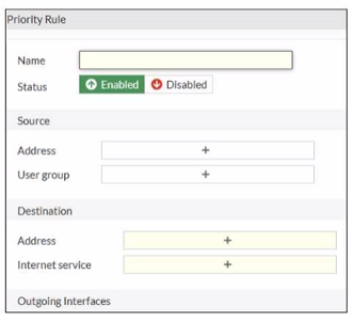
An administrator configures SD-WAN rules for a DIA setup using the FortiGate GUI. The page to configure the source and destination part of the rule looks as shown in the exhibit. The GUI page shows no option to configure an application as the destination of the SD-WAN rule Why?
Refer to the exhibit.
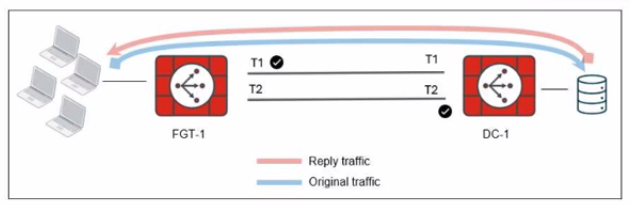
The administrator analyzed the traffic between a branch FortiGate and the server located in the data center, and noticed the behavior shown in the diagram.
When the LAN clients located behind FGT1 establish a session to a server behind DC-1, the administrator observes that, on DC-1, the reply traffic is routed overT2. even though T1 is the preferred member in
the matching SD-WAN rule.
What can the administrator do to instruct DC-1 to route the reply traffic through the member with the best performance?
When asymmetric routing is observed (such as reply traffic not following the optimal path), the solution is: 'The auxiliary-session feature, enabled under config system settings, allows FortiGate to consider multiple egress interfaces for reply traffic, not just the original ingress interface. This is crucial for SD-WAN environments where the best path may differ between forward and return directions, especially when performance or policy rules are dynamically evaluated.' Activating this ensures reply traffic is always sent on the member with the best real-time metrics. Reference:
[FCSS_SDW_AR-7.4 1-0.docx Q23]
FortiOS 7.4 CLI Reference, 'auxiliary-session for SD-WAN Path Optimization'
Refer to the exhibits.
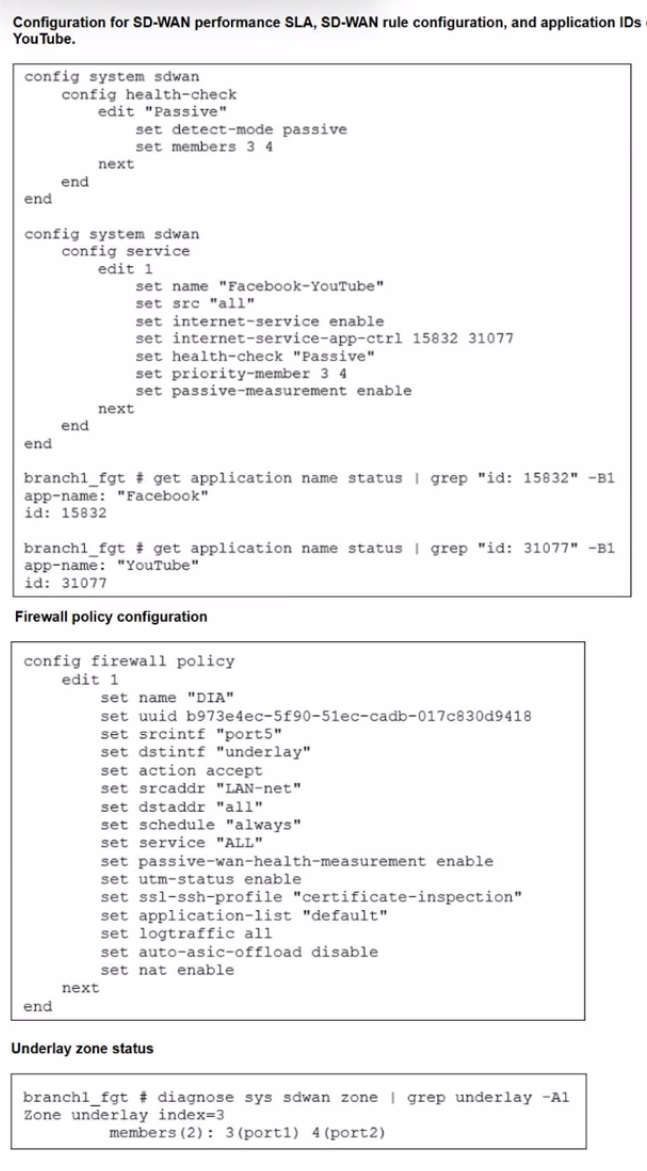
The exhibits show the configuration for SD-WAN performance. SD-WAN rule, the application IDs of Facebook and YouTube along with the firewall policy configuration and the underlay zone status.
Which two statements are true about the health and performance of SD-WAN members 3 and 4? (Choose two.)
Within the context of SD-WAN, what does SIA correspond to?

