At ValidExamDumps, we consistently monitor updates to the Fortinet FCP_GCS_AD-7.6 exam questions by Fortinet. Whenever our team identifies changes in the exam questions, objectives, focus areas or requirements, We immediately update our exam questions for both PDF and online practice exams. This commitment ensures our customers always have access to the most current and accurate questions. By preparing with these up to date and 100% exam domain coverage questions, our customers can successfully pass the Fortinet FCP - Google Cloud Security 7.6 Administrator exam on their first attempt without needing additional materials or study guides.
Other certification materials providers often include outdated or removed questions by Fortinet in their FCP_GCS_AD-7.6 exam. These outdated questions lead to customers failing their Fortinet FCP - Google Cloud Security 7.6 Administrator exam. In contrast, we ensure our questions bank includes only precise and up-to-date questions. Our main priority is your success in the Fortinet FCP_GCS_AD-7.6 exam, not profiting from selling obsolete exam questions in PDF or Online Practice Test.
Your organization has deployed an active-active high-availability (HA) FortiGate cluster in Google Cloud. You have noticed a significant increase in asymmetrical traffic flow.
Which two actions can you take to mitigate the issue? (Choose two.)
Enabling source NAT ensures consistent source IPs, promoting symmetric traffic flow.
Symmetric hashing on the load balancer helps distribute traffic flows evenly and consistently across cluster members, reducing asymmetric routing.
You are tasked with deploying a load balancer in Google Cloud that does not terminate sessions arriving from outside the VPC and that forwards traffic to the organization's internal web servers.
Which load balancer type should you deploy?
An external passthrough load balancer forwards traffic without terminating sessions, preserving the original client connection, which is ideal for forwarding traffic directly to internal web servers.
Google Cloud network services offer vast functionality and inter-connectivity between the cloud and on-premises networks.
Which three additional functions does FortiGate offer when deployed in Google Cloud to complement the native services offered by Google Cloud? (Choose three.)
FortiGate provides SSL VPN capabilities for secure remote access.
It offers SSL inspection to decrypt and inspect encrypted traffic for threats.
FortiGate supports Secure SD-WAN with deep application visibility and control, enhancing network performance and security beyond native Google Cloud services.
Refer to the exhibit.
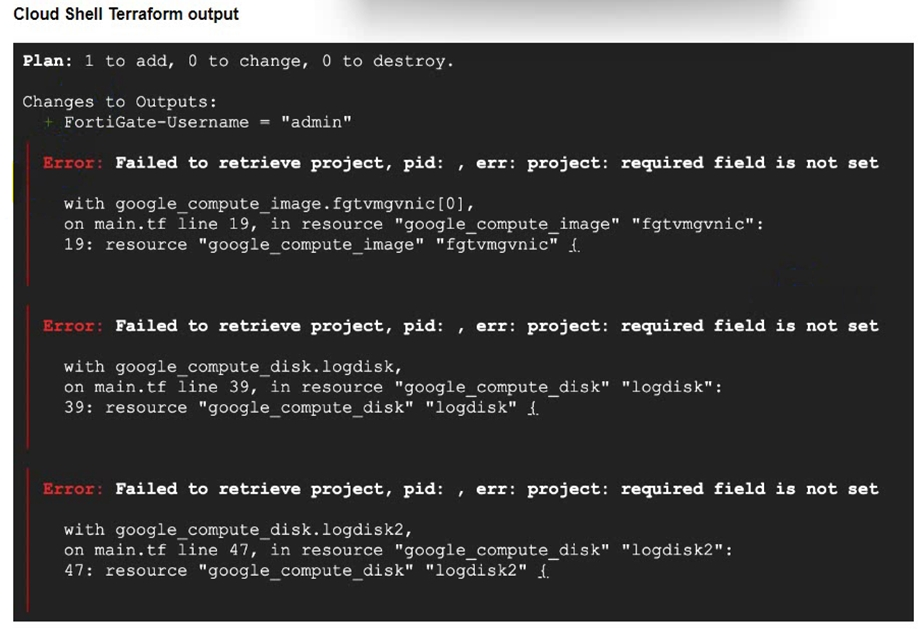
An administrator is attempting to deploy a Terraform template using Google Cloud Shell.
Which step must the administrator take to solve the error?
The error indicates the Google Cloud project is not set, which is required for Terraform to access resources. Setting the project with gcloud config set project [PROJECT_ID] resolves this by specifying the active project in Cloud Shell.
Which architecture inspection type in Google Cloud is most closely associated with Google Cloud Interconnect?
Google Cloud Interconnect connects on-premises networks with Google Cloud, enabling hybrid cloud environments. Inspection related to this connectivity focuses on hybrid cloud traffic flows.

