Ericsson ECP-206 Practice Exam Questions & Answers
7 Free Questions
· Last reviewed: October 19, 2026
· Prepared & Reviewed by the ValidExamDumps Editorial Team
Exam Facts
Ericsson ECP-206 Exam Details
Key details for this exam, checked against the published exam outline
60
Practice Questions (Our Bank)
- Exam Code
- ECP-206
- Full Name
- Ericsson Certified Associate - IP Networking
- Issuing Body
- Ericsson
- Question Format (Our Bank)
- Multiple Choice
Practice Questions
Free ECP-206 Practice Questions
Each question shows the correct answer and an explanation of why it is right
VA
ValidExamDumps Editorial Team
Every question and its answer is checked by our ECP-206 exam
preparation team, who also write the explanation shown with each one.
How we research and review these pages
Which statement accurately defines an Autonomous System (AS)?
Correct Answer:
A
Explanation
The statement that accurately defines an Autonomous System (AS) is that an AS is a set of routers under a single administration, using an interior gateway protocol and common metrics to route packets within the AS. An AS is a logical grouping of networks that share a common routing policy and operate under a single administrative authority. An AS can be a single network or a collection of networks that are interconnected by routers. An AS uses an interior gateway protocol (IGP), such as OSPF or IS-IS, to exchange routing information within the AS. An IGP uses common metrics, such as hop count or bandwidth, to determine the best path to each destination within the AS. An AS also has a unique number assigned by IANA, called an AS number (ASN), which identifies the AS in interdomain routing .
Which route type is restricted in an OSPF stub area?
Correct Answer:
D
What is the function of LSR from an LDP perspective?
Correct Answer:
D
How do peers recognize each other's ability to use MP-BGP extensions?
Correct Answer:
A
Explanation
Peers recognize each other's ability to use MP-BGP extensions by advertising the ability using the capabilities field during the session establishment. MP-BGP is an extension to BGP that allows BGP to carry routing information for multiple network layer protocols, such as IPv6, VPNv4, multicast, etc. To support MP-BGP, peers need to exchange their capabilities during the session establishment phase, which consists of three steps: open, keepalive, and update. In the open message, peers can include an optional parameter called capabilities, which indicates what kind of address families and subsequent address families they can support.If both peers agree on a common set of capabilities, they can proceed to exchange routing information for those address families using update messages56.
Review the exhibit.
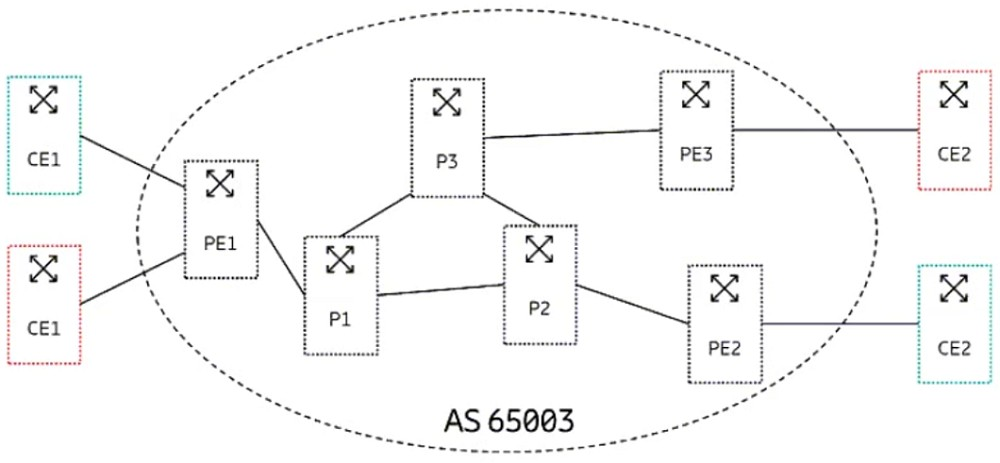
A service provider wants to connect the sites for two customers (indicated in red and green in the exhibit). The two customers are using the same IP ranges 192.168.0.0/16.
Referring to the exhibit, what should the service provider do to accomplish this task?
Correct Answer:
A
What is the correct ordering (outer to inner) of packet headers in an IP/MPLS packet?
Correct Answer:
A
What is the purpose of the RT attribute?
Correct Answer:
A
Full Access
Get the complete ECP-206 question set
- 60 questions covering all exam domains
- Correct answers with explanations, like the free questions above
- PDF and online practice test
- 90 days of free updates
Study Guide
What the Ericsson ECP-206 Exam Covers
9 domains from the Ericsson ECP-206 exam outline, with approximate weightings. Every sample question above is tagged
with the domain it comes from
Domain 1: IP Addressing (IPv4, IPv6)
For network engineers and technicians, this exam component evaluates understanding of IP addressing frameworks, subnet creation, and IP address management within Ericsson network environments. Understanding how IPv4 and IPv6 addressing schemes work is foundational to all network design and configuration tasks.
Domain 2: Subnetting
This section evaluates the knowledge of CIDR notation, the capacity to construct efficient subnets, and the network engineers' and technicians' ability to compute subnet masks. Proficiency here directly impacts your ability to design scalable and secure network architectures.
Domain 3: Routing Protocols (OSPF, BGP, RIP)
For network engineers, this exam section evaluates skills in setting up, diagnosing issues, and enhancing the performance of routing protocols on Ericsson router systems. This area tests both theoretical knowledge of how these protocols function and practical ability to optimize them in production networks.
Sample questions from this domain above:
Q1Q2Q3Q4Q6
Domain 4: Network Address Translation (NAT)
For network engineers, this portion tests knowledge of NAT principles, setup procedures, and strategies for efficiently managing networks utilizing NAT. Candidates need to understand when and how to deploy NAT, including its limitations and interactions with other network services.
Sample questions from this domain above:
Q5Q7
Domain 5: Network Security and Firewalls
This test section assesses knowledge of firewall configuration, Access Control List (ACL) implementation, and adherence to security best practices for network engineers and security specialists. Security concepts are critical for protecting Ericsson network infrastructure from unauthorized access and threats.
Domain 6: Network Troubleshooting
For network engineers, this section emphasizes network maintenance and diagnostic tools. It evaluates the ability to address critical network issues specific to Ericsson network infrastructures. Real-world troubleshooting requires systematic approaches to identifying and resolving connectivity and performance problems.
Domain 7: Network Troubleshooting
For network engineers, this section emphasizes network maintenance and diagnostic tools. It evaluates the ability to address critical network issues specific to Ericsson network infrastructures. Real-world troubleshooting requires systematic approaches to identifying and resolving connectivity and performance problems.
Domain 8: Network Troubleshooting
For network engineers, this section emphasizes network maintenance and diagnostic tools. It evaluates the ability to address critical network issues specific to Ericsson network infrastructures. Real-world troubleshooting requires systematic approaches to identifying and resolving connectivity and performance problems.
Domain 9: Ericsson IP networking products and solutions
This exam component assesses network engineers' familiarity with Ericsson's range of networking hardware, including routers, switches, and other IP networking solutions offered by the company. Hands-on knowledge of Ericsson-specific tools and equipment configurations is essential for managing their network environments.
FAQ
ECP-206 Exam FAQ
Common questions about the exam itself
What networking background do I need before taking ECP-206?
The exam assumes you have practical experience with IP networking concepts and ideally some hands-on work with routers, switches, or network administration. While the exam covers foundational concepts like subnetting and IP addressing, it builds on that foundation quickly, so prior networking knowledge is beneficial.
How long does preparation for ECP-206 typically take?
Most candidates spend between 4 to 8 weeks preparing, depending on their existing network knowledge. This includes studying the exam domains, working through hands-on lab exercises, and gaining practical experience with routing protocols and network troubleshooting tools.
Which exam domains in ECP-206 do candidates struggle with the most?
Routing Protocols and Network Troubleshooting tend to be the most challenging areas because they require both theoretical knowledge and practical problem-solving skills. Candidates often underestimate how much hands-on experience with OSPF, BGP, and diagnostic tools matters on test day.
What does the ECP-206 exam day experience involve?
You will take a proctored exam with multiple question formats covering all seven exam domains. The test evaluates your ability to apply networking concepts to real Ericsson network scenarios, not just memorize definitions.
Is ECP-206 the entry point for Ericsson networking certifications?
Yes, the Ericsson Certified Associate designation is the foundation level. After achieving ECP-206, you can progress to higher-level Ericsson certifications in IP networking and related specializations.
How long is the ECP-206 certification valid after I pass?
Ericsson's official validity period and any renewal requirements are not published in publicly available sources. You should contact Ericsson directly to confirm how long your certification remains current.
What Ericsson IP networking products should I study before the exam?
Focus on understanding Ericsson routers and switches used in enterprise and service provider networks. While the exam covers general IP networking principles, having practical exposure to Ericsson hardware configurations and management interfaces strengthens your performance.
Can I retake ECP-206 if I fail, and are there restrictions?
Ericsson's official retake policy and any waiting periods between attempts are not published online. Check with the exam delivery provider or Ericsson directly for current retake procedures and costs.
What job roles is ECP-206 intended for?
The certification targets network engineers, network technicians, and security specialists working with Ericsson IP networking infrastructure. It validates expertise in designing, configuring, and troubleshooting IP networks in enterprise and service provider environments.
How does ECP-206 compare to vendor-neutral networking certifications?
ECP-206 is Ericsson-specific, so it emphasizes Ericsson products and solutions. If you hold vendor-neutral certifications like Cisco CCNA, ECP-206 builds on that foundation by teaching how those concepts apply specifically within Ericsson environments.

