At ValidExamDumps, we consistently monitor updates to the Cisco 350-601 exam questions by Cisco. Whenever our team identifies changes in the exam questions, objectives, focus areas or requirements, We immediately update our exam questions for both PDF and online practice exams. This commitment ensures our customers always have access to the most current and accurate questions. By preparing with these up to date and 100% exam domain coverage questions, our customers can successfully pass the Cisco Implementing and Operating Cisco Data Center Core Technologies exam on their first attempt without needing additional materials or study guides.
Other certification materials providers often include outdated or removed questions by Cisco in their 350-601 exam. These outdated questions lead to customers failing their Cisco Implementing and Operating Cisco Data Center Core Technologies exam. In contrast, we ensure our questions bank includes only precise and up-to-date questions. Our main priority is your success in the Cisco 350-601 exam, not profiting from selling obsolete exam questions in PDF or Online Practice Test.
Refer to the exhibit.
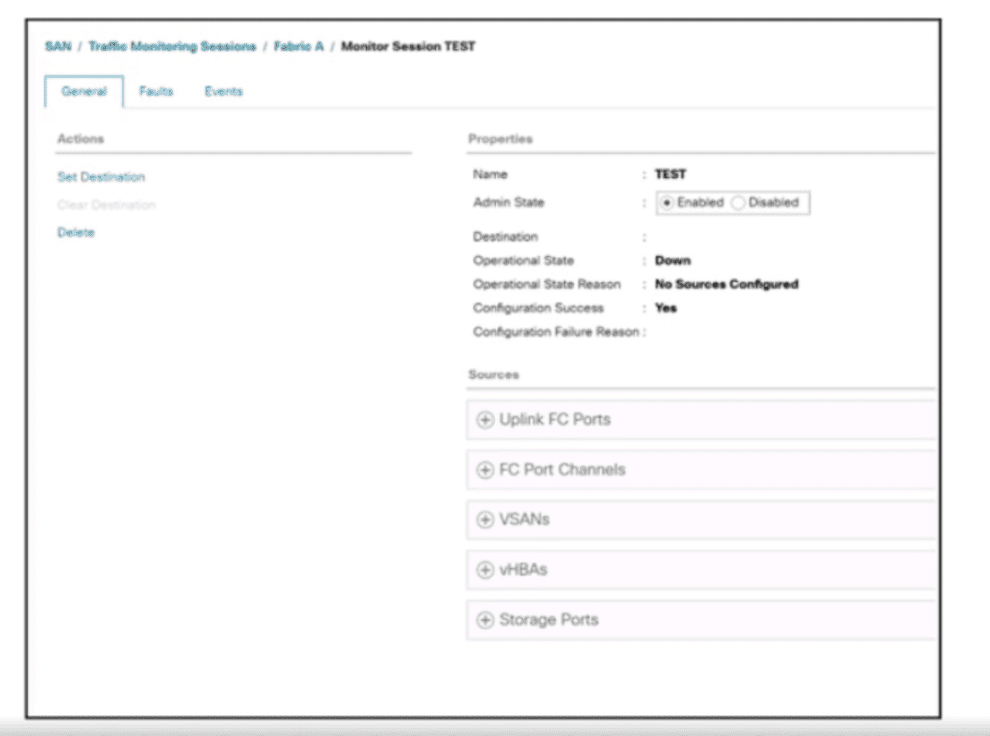
Refer to the exhibit. Users report SAN traffic packet loss on a blade server that is managed by using Cisco UCS Manager. An engineer must implement a SPAN feature to an external Fibre Channel analyzer. Which configuration source in the TEST monitoring session must the engineer select?
Refer to the exhibit.
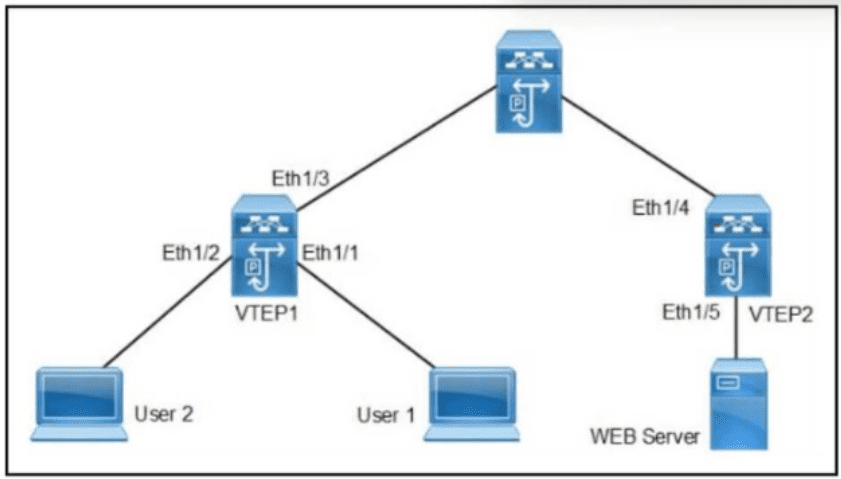
Refer to the exhibit. User 1 and user 2 are connected to the VTEP1 switch. The users can reach the WEB server. A monitoring tool shows degrading network performance that consumes the interface bandwidth between VTEP1 and the spine switch. An engineer noticed that user 1 sends many ARP requests. Which command set on VTEP1 mitigates the issue without preventing user 1 from sending ARP requests?
What is the function of network file storage?
A customer asks an engineer to develop an orchestration solution to automate repetitive tasks. The customer operations team must integrate the tool with its existing automation framework. The customer asks for the tool to support these requirements:
* The customer's security requirements mandate the use of SSH transport.
* No extra software must be installed on the managed systems.
* The support staff has limited knowledge of scripting languages, so the solution must be easy to read and use declarative language.
Which solution meets these requirements?
The correct answer is C. Ansible because it is the one option that matches all three stated requirements at the same time. Official Ansible documentation describes Ansible as an agentless automation tool installed on a control node, and states that it manages remote systems over SSH without requiring additional daemons or software on the managed nodes. Ansible documentation also states that its playbooks are written in YAML, which is intended to be easier for humans to read and write, making it a strong fit for teams with limited scripting experience.
The other options do not fit as cleanly. Chef can use SSH in agentless mode, but Chef's core model is based on Chef Infra Client, which is an agent, and its automation logic is built around recipes rather than simple declarative YAML playbooks. Puppet supports declarative configuration and can use SSH through Bolt, but Puppet commonly relies on installed agents in standard deployments. PowerShell is primarily a scripting language, not the best match for the requirement for an easy-to-read declarative orchestration tool. Therefore, Ansible is the best and verified choice.
An engineer requires a solution to automate the configuration and deployment of remote network devices for a customer. The engineer must keep these considerations in mind
The customer's environment is based on industry-accepted standards and requires a solution that meets these standards.
The security requirements mandate the use of a secure transport mechanism between the automation software and target devices such as SSH or TLS.
The solution must be implemented using a human-readable language and provide the functionality to format data in XML or JSON.
Which solution must be used to meet these requirements?

