The Cisco 350-201 exam validates your ability to perform cybersecurity operations using core security technologies. Designed for professionals pursuing the Cisco Certified CyberOps Professional credential, this assessment covers Performing CyberOps Using Core Security Technologies and tests both foundational knowledge and practical decision-making. This page outlines the exam structure, key topics, and effective study strategies to help you prepare confidently.
Use this topic map to guide your study for Cisco 350-201 (Performing CyberOps Using Core Security Technologies) within the Cisco Certified CyberOps Professional path.
The 350-201 exam measures both conceptual understanding and practical judgment through varied question types that reflect real-world security operations.
Questions increase in complexity and emphasize practical application, ensuring candidates can handle both routine monitoring and urgent incident scenarios.
Effective preparation maps the four exam domains to a structured study schedule. Allocate time proportionally to each topic, practice with realistic scenarios, and review weak areas before your test date.
Explore other Cisco certifications: view all Cisco exams.
Strengthen your preparation with up-to-date resources from validexamdumps.com. These materials align to 350-201 and cover practical scenarios with clear explanations.
Visit the exam page to download the PDF, Online Practice Test, or get a bundle discount offer for both formats: Performing CyberOps Using Core Security Technologies.
While all four domains are important, 2.0 Techniques and 3.0 Processes typically account for a larger portion of the exam. Invest extra study time in detection methods, log interpretation, and incident response workflows, as these directly reflect daily SOC responsibilities.
Fundamentals (1.0) provide the knowledge base, Techniques (2.0) are the tools and methods you apply, Processes (3.0) structure how you respond, and Automation (4.0) makes operations efficient at scale. In practice, you detect a threat using techniques, follow incident response processes, then automate similar detections in the future.
Focus on labs that involve log analysis, packet capture review, and tool navigation. Set up a home lab or use free Cisco learning environments to practice parsing security data, identifying anomalies, and documenting findings. Hands-on experience with SIEM dashboards and command-line tools directly supports exam scenarios.
Many candidates overlook process documentation and communication steps in incident response, focusing only on technical detection. Others underestimate the importance of automation concepts in modern SOCs. Read scenario questions carefully to identify what the organization needs, not just what is technically possible.
Review weak topic areas identified in practice tests rather than re-reading strong areas. Take one full-length timed practice test three to four days before your exam, review all incorrect answers, then do light review of key definitions and workflows the day before. Avoid cramming new material in the final 24 hours.
Engineers are working to document, list, and discover all used applications within an organization. During the regular assessment of applications from the HR backup server, an engineer discovered an unknown application. The analysis showed that the application is communicating with external addresses on a non- secure, unencrypted channel. Information gathering revealed that the unknown application does not have an owner and is not being used by a business unit. What are the next two steps the engineers should take in this investigation? (Choose two.)
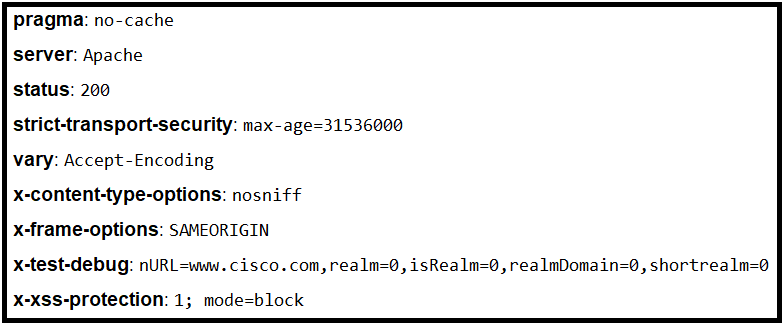
Refer to the exhibit.

Cisco Advanced Malware Protection installed on an end-user desktop automatically submitted a low prevalence file to the Threat Grid analysis engine. What should be concluded from this report?
A threat actor attacked an organization's Active Directory server from a remote location, and in a thirty-minute timeframe, stole the password for the administrator account and attempted to access 3 company servers. The threat actor successfully accessed the first server that contained sales data, but no files were downloaded. A second server was also accessed that contained marketing information and 11 files were downloaded. When the threat actor accessed the third server that contained corporate financial data, the session was disconnected, and the administrator's account was disabled. Which activity triggered the behavior analytics tool?
A security architect in an automotive factory is working on the Cyber Security Management System and is implementing procedures and creating policies to prevent attacks. Which standard must the architect apply?
An organization installed a new application server for IP phones. An automated process fetched user credentials from the Active Directory server, and the application will have access to on-premises and cloud services. Which security threat should be mitigated first?