The Cisco 300-910 exam validates your ability to implement DevOps solutions and practices across Cisco platforms. This credential is part of the Cisco Certified DevNet Professional and Cisco Certified DevNet Specialist pathways, designed for engineers who automate infrastructure, manage application delivery, and optimize cloud deployments. This page outlines the exam structure, core topics, and practical preparation strategies to help you study efficiently and confidently.
Use this topic map to guide your study for Cisco 300-910 (Implementing DevOps Solutions and Practices using Cisco Platforms) within the Cisco Certified DevNet Professional and Cisco Certified DevNet Specialist pathways.
The 300-910 exam uses multiple-choice and scenario-based questions to assess both foundational knowledge and applied decision-making in real DevOps contexts. Questions progress in difficulty and reward candidates who understand how tools and practices interconnect.
Questions emphasize practical application, requiring you to think beyond memorization and connect concepts across the entire DevOps lifecycle.
An effective study plan maps each topic to weekly goals, combines practice questions with hands-on labs, and includes timed reviews to build exam pacing. Allocate more time to topics that carry higher exam weight and areas where you lack direct experience.
Explore other Cisco certifications: view all Cisco exams.
Strengthen your preparation with up‑to‑date resources from validexamdumps.com. These materials align to 300-910 and cover practical scenarios with clear explanations.
Visit the exam page to download the PDF, Online Practice Test, or get a bundle discount for both formats: Implementing DevOps Solutions and Practices using Cisco Platforms.
CI/CD Pipeline and Packaging and Delivery of Applications typically account for a larger portion of the exam. However, all six domains are tested, and Security and Logging/Monitoring are increasingly emphasized in recent versions. Allocate study time proportionally, but ensure you have baseline competency across all areas.
In practice, they overlap continuously. A CI/CD pipeline (1.0) builds and packages applications (2.0) using automated infrastructure (3.0) deployed to cloud platforms (4.0), while security controls (6.0) are embedded throughout, and logging and monitoring (5.0) track the entire process. Understanding these connections helps you answer scenario questions and troubleshoot real issues.
Hands-on experience is valuable but not mandatory if you study effectively. Prioritize labs that let you build a simple CI/CD pipeline, containerize an application, write infrastructure-as-code, and set up basic monitoring. Even a few hours with Docker, Kubernetes, Terraform, and a CI tool like Jenkins will significantly boost your confidence and understanding.
Many candidates confuse similar tools (e.g., Kubernetes vs. Docker Swarm) or miss nuances in security best practices like secrets management. Others rush scenario questions without reading all options carefully. Weak areas often stem from insufficient hands-on practice or not reviewing explanations after practice tests. Slow down on scenario items and always understand the "why" behind correct answers.
Focus on your weakest topics first, using practice questions and flashcards for quick reinforcement. Take one full-length timed practice test mid-week to identify remaining gaps, then drill those specific areas. In the final 2-3 days, review high-level concepts and key terminology rather than learning new material. Ensure adequate sleep and manage test anxiety by practicing breathing techniques during your mini-mocks.
A CI/CD pipeline that builds infrastructure components using Terraform must be designed. A step in the pipeline is needed that checks for errors in any of the .tf files in the working directory. It also checks the existing state of the defined infrastructure.
Which command does the pipeline run to accomplish this goal?
https://www.terraform.io/docs/cli/commands/validate.html 'use the terraform plan command instead, which includes an implied validation check.'
A DevOps engineering wants to build an application implementation based on the CI/CD pipeline model. Which service should be used to provide hosted continuous service for open and private projects?
Configuration changes to the production network devices are performed by a CI/CD pipeline. The code repository and the CI tool are running on separate servers. Some configuration changes are pushed to the code repository, but the pipeline did not start.
Why did the pipeline fail to start?
A webhook is basically a callback URL that is triggered when certain events occur, such as a code commit. If the webhook call from the code repository does not reach the CI server, then the pipeline will not start. According to the Cisco Implementing DevOps Solutions and Practices using Cisco Platforms (DEVOPS) Study Manual, 'A webhook is a web-based feature that enables a remote service to communicate with a local service, usually through a web server. Webhooks are used to trigger an action when a specific event occurs, usually in a remote service or application.'
Refer to the exhibit.
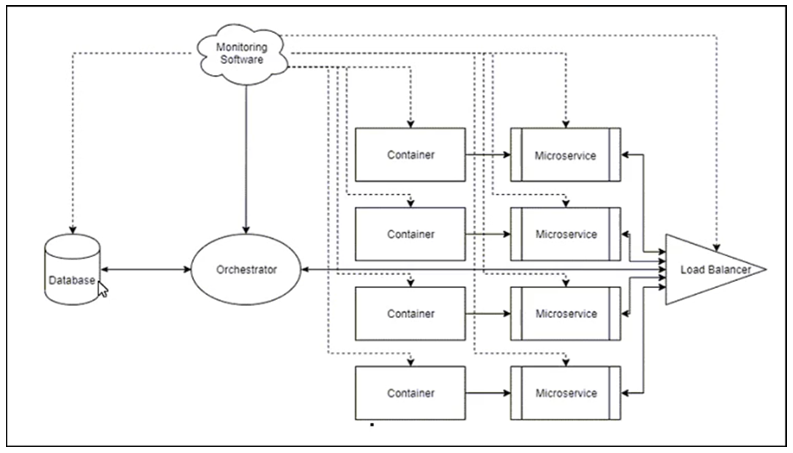
How does the architecture respond to a usage spike?
Which Docker command is used to start an interactive Bash shell in a running container named ''test''?

