Cisco 300-740 Practice Exam Questions & Answers
7 Free Questions
· Last reviewed: October 14, 2026
· Prepared & Reviewed by the ValidExamDumps Editorial Team
Exam Facts
Cisco 300-740 Exam Details
Key details for this exam, checked against the published exam outline
61
Practice Questions (Our Bank)
90 minutes
Exam Duration
825 out of 1000
Passing Score
USD 300
Official Exam Fee
- Exam Code
- 300-740
- Full Name
- Designing and Implementing Secure Cloud Access for Users and Endpoints
- Issuing Body
- Cisco
- Question Format (Our Bank)
- Multiple Choice, Drag & Drop
- Delivery
- Online proctored or at a Pearson VUE test centre
- Eligibility
- No formal prerequisites
Practice Questions
Free 300-740 Practice Questions
Each question shows the correct answer and an explanation of why it is right
VA
ValidExamDumps Editorial Team
Every question and its answer is checked by our 300-740 exam
preparation team, who also write the explanation shown with each one.
How we research and review these pages
Refer to the exhibit.
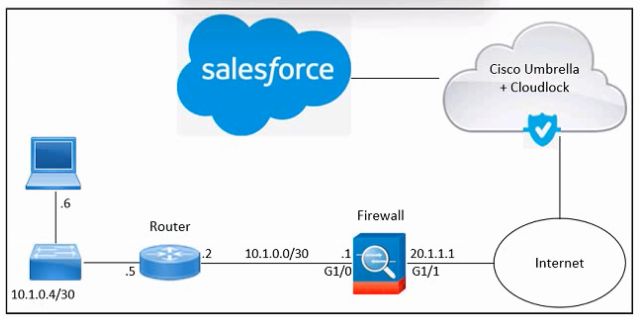
Refer to the exhibit. An engineer must integrate Cisco Cloudlock with Salesforce in an organization. Despite the engineer's successful execution of the Salesforce integration with Cloudlock, the administrator still lacks the necessary visibility. What should be done to meet the requirement?
Correct Answer:
B
Explanation
For Cloudlock to gain visibility into Salesforce data and activities, the integration requires proper permissions on the Salesforce side. Enabling View All Data permission in Salesforce allows Cloudlock to access and monitor all files, records, and user activities within the organization. Without this permission, Cloudlock cannot see the data it needs to protect, defeating the purpose of the integration. Other options like enabling API access or adjusting connector settings don't specifically address the visibility requirement.
A security analyst detects an employee endpoint making connections to a malicious IP on the internet and downloaded a file named Test0511127691C.pdf. The analyst discovers the machine is infected by trojan malware. What must the analyst do to mitigate the threat using Cisco Secure Endpoint?
Correct Answer:
D
Explanation
When a trojan malware infection is detected on an endpoint, immediate isolation is the critical first step to prevent the malware from spreading to other systems or exfiltrating data. Cisco Secure Endpoint provides endpoint isolation capabilities through the Computers tab. Isolation stops network communications while allowing the security team to investigate and remediate the threat. Simply quarantining files or running scans does not address the active threat posing immediate risk to the network.
Refer to the exhibit.
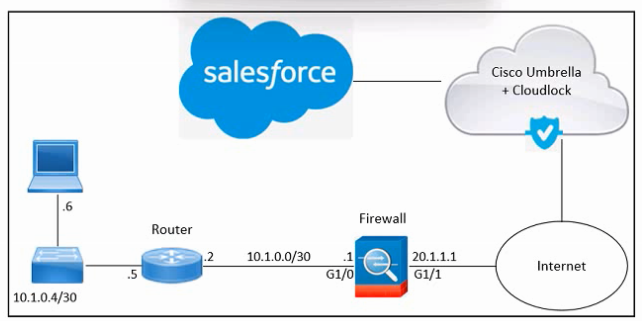
Refer to the exhibit. An engineer must enable access to Salesforce using Cisco Umbrella and Cisco Cloudlock. These actions were performed:
From Salesforce, add the Cloudlock IP address to the allow list
From Cloudlock, authorize Salesforce
However, Salesforce access via Cloudlock is still unauthorized. What should be done to meet the requirements?
Correct Answer:
A
Explanation
Cloudlock needs API access to Salesforce to function properly as a CASB solution. While adding Cloudlock's IP to the allow list and authorizing Salesforce are necessary steps, granting API access through the Salesforce admin page is the critical permission that allows Cloudlock to make authenticated API calls to Salesforce. Without this API access, Cloudlock cannot retrieve or monitor Salesforce data even if the IP is allowed and the general authorization is in place.
Which concept is used in the Cisco SAFE key reference model?
Correct Answer:
A
Explanation
Cisco Telemetry Broker is an operational tool that aggregates and manages telemetry data from various sources. Data brokering refers to the function of collecting, normalizing, and distributing data across security platforms. This supports the Operations domain requirement of providing cloud application visibility and traffic analysis. The telemetry broker acts as a central hub for security intelligence.
Refer to the exhibit.
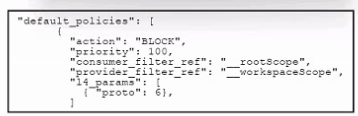
Refer to the exhibit. An engineer configured a default segmentation policy in Cisco Secure Workload to block SMTP traffic. During testing, it is observed that the SMTP traffic is still allowed. Which action must the engineer take to complete the configuration?
Correct Answer:
C
Explanation
Cisco Secure Workload uses policy configurations to control network traffic between workloads. When creating a segmentation policy to block a specific protocol like SMTP, the port number must be explicitly defined in the policy parameters. Adding 'port': [25, 25] specifies that traffic on port 25 (SMTP) should be blocked as intended. Without the port specification in the params section, the policy remains incomplete and the traffic filtering rule does not activate properly.
According to Cisco Security Reference Architecture, which solution provides threat intelligence and malware analytics?
Correct Answer:
C
Explanation
Comprehensive and Detailed Explanation From Exact Extract:
Cisco Talos is Cisco's threat intelligence organization, delivering real-time threat intelligence and malware analytics to help organizations detect and prevent threats before they impact the network. According to the SCAZT guide, Talos provides comprehensive coverage of threat data including signatures, indicators of compromise, and context-driven analytics. This intelligence feeds into Cisco security platforms such as Cisco SecureX and Cisco Secure Endpoint to enhance detection, investigation, and response capabilities. Talos is explicitly referenced in the Threat Response section as the primary source of threat intelligence and malware analytics that supports cloud and endpoint security frameworks.
Refer to the exhibit.
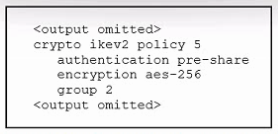
Refer to the exhibit. An engineer must configure a remote access IPsec/IKEv2 VPN that will use SHA-512 on a Cisco ASA firewall. The indicated configuration was applied to the firewall; however, the tunnel fails to establish. Which command must be run to meet the requirement?
Correct Answer:
C
Explanation
IPsec configuration on Cisco ASA requires proper proposal parameters to be set. The ipsec-proposal command followed by the hashing algorithm name (in this case, sha512) defines which cryptographic algorithms are acceptable for the IPsec tunnel. Running 'ipsec-proposal sha512' ensures the ASA will negotiate and use SHA-512 for the IKEv2 handshake. Without this explicit proposal configuration, the ASA might try to use a different or unsupported algorithm, causing the tunnel establishment to fail.
Full Access
Get the complete 300-740 question set
- 61 questions covering all exam domains
- Correct answers with explanations, like the free questions above
- PDF and online practice test
- 90 days of free updates
Domain 1: Concepts
10%
1.1 Describe industry cloud security frameworks such as NIST SP 800-207 and CISA Zero Trust Maturity Model v2.0; 1.2 Select mitigation methods to defend against attacker, tactics, and techniques using the MITRE ATT&CK cloud frameworks (identity providers [IDPs], SaaS, and IaaS); 1.3 Describe security requirements for public cloud platforms such as AWS, Azure, and Google Cloud (GCP); 1.3.a Authentication and access control; 1.3.b Secure using cloud native constructs such as VPCs, security groups, access lists, or multi-cloud defense; 1.3.c Posture and compliance; 1.3.d Shared Responsibility Model; 1.4 Describe operational requirements for public cloud platforms such as AWS, Azure, and Google Cloud (GCP); 1.4.a Visibility and monitoring; 1.4.b Infrastructure; 1.4.c Consumption model (PaaS, IaaS, SaaS); 1.5 Describe private cloud including local hypervisors such as VMware and container orchestration platforms such as Kubernetes; 1.6 Describe how eBPF-based tools (Cilium, Tetragon) provide runtime security observability and enforcement for containerized workloads
Sample question from this domain above:
Q4
Domain 2: Identity
20%
2.1 Describe the use and function of identity intelligence across IDPs; 2.2 Implement user and device authentication via identity certificates; 2.3 Implement multifactor authentication (including phishing resistant) for users and devices with Cisco Duo; 2.4 Implement endpoint posture policies for user access to resources; 2.5 Configure user and device trust using SAML authentication for a mobile or web application; 2.6 Configure SSO and user provisioning using an IDP connection; 2.6.a SCIM; 2.6.b SAML
Domain 3: Policies
30%
3.1 Describe encryption methods for data in transit and at rest in cloud environments such as TLS, IPsec in context, and tunnels; 3.2 Describe how features such as IPS, DLP, and malware protection help provide secure private access; 3.3 Describe the use, purpose, and characteristics of AI Defense; 3.4 Describe AI features in Secure Access such AI Access and AI Guardrails; 3.5 Describe how web application firewalls protect against DDoS; 3.6 Determine security policies for network security edge to enforce application policy; 3.6.a Security services edge (SSE); 3.6.b SDWAN devices such as Cisco Secure Firewall (FTD), Meraki, and Catalyst; 3.7 Determine security policies for application enforcement using Cisco Secure Workload and enforcement agents; 3.7.a Lateral movement prevention; 3.7.b Microsegmentation; 3.7.c Vulnerability assessment and response; 3.7.d Application discovery and monitoring; 3.7.e Policy creation, validation, and analysis
Domain 4: Access
30%
4.1 Configure DNS security; 4.2 Configure Secure Web Gateway; 4.3 Configure Data Loss Protection; 4.4 Configure CASB; 4.5 Configure secure private access for workloads; 4.5.a Resource connector or IPsec backhaul; 4.5.b Branch connectivity; 4.6 Configure secure private access for users; 4.6.a VPN as a service with ISE as a RADIUS server using Secure Access and Cisco Secure Client; 4.6.b Digital experience monitoring using Thousand Eyes and Secure Access; 4.6.c Zero-trust access (clientless and client-based) using Secure Access, Cisco Secure Client, QUIC, and MASQUE
Sample questions from this domain above:
Q1Q3Q5Q7
Domain 5: Operations
10%
5.1 Select the process or tool that provides cloud application (includes workloads and containers) visibility, microsegmentation, traffic analysis, and policy enforcement based on security requirements; 5.2 Interpret traffic flow and telemetry reports for baseline and compliance behavior analysis; 5.3 Interpret Cisco Secure Access dashboards; 5.4 Integrate Cisco Secure Access with Cisco XDR and Splunk Enterprise to enhance SOC operations
Sample questions from this domain above:
Q2Q6
FAQ
300-740 Exam FAQ
Common questions about the exam itself
What job role is the 300-740 exam designed for?
The exam is designed for network security engineers, security architects, cloud security specialists, and IT professionals involved in designing and implementing secure cloud access solutions. It validates expertise in architecting and deploying secure access for users and endpoints in cloud environments.
Is the 300-740 a prerequisite for other Cisco certifications?
No, the 300-740 has no formal prerequisites and is accessible to IT professionals at all experience levels. However, passing it satisfies the concentration exam requirement for the Cisco Certified Network Professional (CCNP) Security certification when combined with a required core exam.
How does the 300-740 fit into the CCNP Security certification track?
The 300-740 is a concentration exam for CCNP Security. You must pass a CCNP Security core exam (such as 350-701) and this concentration exam to earn the full CCNP Security certification. Passing 300-740 alone earns the Cisco Certified Specialist - Secure Cloud Access credential.
What is the most challenging domain on the 300-740 exam?
Network and Cloud Security is the heaviest domain at 30 percent of the exam. It covers URL filtering, advanced app control, protocol blocking, web application firewalls, and SaaS application policies. Candidates should spend significant preparation time understanding Cisco Secure Firewall, proxy configurations, and policy enforcement at the security services edge.
How long should I prepare for the 300-740 exam?
Most candidates prepare for 4-8 weeks depending on their existing cloud security knowledge and experience with Cisco tools like SecureX, Umbrella, Duo, and Secure Workload. Hands-on experience with implementing Cisco security solutions significantly reduces preparation time.
Can I take the 300-740 exam online or do I need to visit a test centre?
You can choose either option. The exam is available both as an online proctored exam and at a Pearson VUE test centre. Both delivery methods are 90 minutes with the same question format and passing requirements.
What is the exam format for 300-740?
The exam contains 60 questions and lasts 90 minutes. Questions can be multiple-choice, multiple-response, drag-and-drop, scenario, and design-analysis style items. You need to answer all questions within the time window.
Can I retake the 300-740 exam if I fail?
Yes, you can retake the exam. Each exam attempt requires a separate fee of USD 300. Pearson VUE allows you to reschedule your exam as needed, though specific retake scheduling windows depend on your regional testing centre policies.
How long is the 300-740 certification valid?
Cisco does not publicly disclose the standard validity period for the Secure Cloud Access Specialist certification. Check the official Cisco certification page or contact Cisco Learning Network for the specific renewal timeline and recertification requirements.
What Cisco tools and products does the 300-740 exam cover?
The exam covers Cisco SecureX, Cisco XDR, Cisco Duo, Cisco ISE, Cisco Catalyst SD-WAN, Cisco Umbrella, Cisco Secure Firewall (FTD and ASA), Cisco Secure Workload, Cisco Secure Analytics, Cisco Secure Cloud Insights, and related cloud security solutions for designing integrated SASE and zero-trust architectures.

