At ValidExamDumps, we consistently monitor updates to the Cisco 300-635 exam questions by Cisco. Whenever our team identifies changes in the exam questions, objectives, focus areas or requirements, We immediately update our exam questions for both PDF and online practice exams. This commitment ensures our customers always have access to the most current and accurate questions. By preparing with these up to date and 100% exam domain coverage questions, our customers can successfully pass the Cisco Automating Cisco Data Center Networking Solutions exam on their first attempt without needing additional materials or study guides.
Other certification materials providers often include outdated or removed questions by Cisco in their 300-635 exam. These outdated questions lead to customers failing their Cisco Automating Cisco Data Center Networking Solutions exam. In contrast, we ensure our questions bank includes only precise and up-to-date questions. Our main priority is your success in the Cisco 300-635 exam, not profiting from selling obsolete exam questions in PDF or Online Practice Test.
Which two components are required from the Cisco Intersight REST API Authentication? (Choose two.)
Cisco Intersight REST API requires a secure authentication process that involves creating a SHA256 hash of the message body and headers. This ensures that the message integrity is maintained and verifies that the message has not been tampered with during transit. Even if the message body is empty, a SHA256 hash is still required.Additionally, the use of RSA private keys enhances security, but the specific key size requirement was not mentioned in the provided resources6
https://github.com/ansible/ansible/pull/51309/files/a68de94464ad34b4e6836f86662ef0ba6060a2e9
Which NX-API request queries the MAC address table?
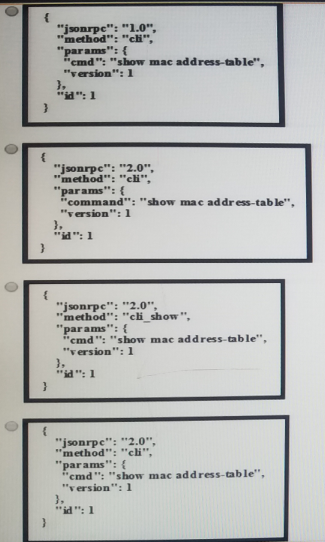
The correct NX-API request to query the MAC address table is the one that uses the method corresponding to the CLI command that displays the MAC address table on a Cisco device. In Cisco NX-OS, this CLI command isshow mac address-table. The JSON object should have a method field with value'cli'and params field with a cmd field set to'show mac address-table'. Option B is verified as it matches these criteria.Reference:=
Implementing Automation for Cisco Data Center Solutions (DCAUI) course
Cisco Data Center Training Videos
Refer to the exhibit.
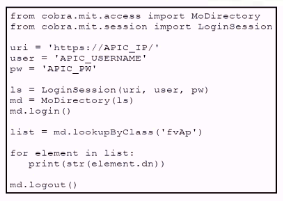
A Python script using ACI Cobra SDK has been constructed. What is the result when running this script?
The Python script uses the ACI Cobra SDK to interact with Cisco's Application Centric Infrastructure (ACI). It logs into the APIC and retrieves a list of all application profiles ('fvAp'), then prints out their distinguished names (dn), which uniquely identify each application profile within the ACI fabric.Reference:
Cisco Developer Network
Cisco Learning Network
Which action allows Docker daemon persistence during switchover on the Cisco Nexus 9500 Series Switches running Cisco NX-OS?
To ensure Docker daemon persistence during a switchover on Cisco Nexus 9500 Series Switches running Cisco NX-OS, the Docker configuration must be changed to include the live restore option. This option allows running containers to continue operating during the daemon downtime, which is particularly useful during a switchover.Reference: Cisco Nexus 9500 Series documentation and Docker official documentation.
An engineer is implementing a Cisco Nexus switch. Which command executes an Ansible playbook called n9k.yml?
To execute an Ansible playbook namedn9k.yml, the correct command isansible-playbook n9k.yml. This command runs the specified playbook, allowing you to automate tasks on the Cisco Nexus switch using Ansible.Reference:
Ansible Documentation - Run Your First Command and Playbook
Ansible Documentation - Playbooks Intro
Automating Apache Web Server Deployment with Ansible Playbooks
Controlling playbook execution: strategies and moreuser QUESTIO N NO: 63 Refer to the exhibit: https://www.bing.com/images/blob?bcid=RLdoSzzf3RgHNOMBpJdfO8MMmWRU...90 Refer to the exhibit: The code should create a new tenant named Cisco via the Cobra SDK, which shows up after the execution of this script in the APIC dashboard. Which code must be inserted into the red box to create this tenant? A. Tenant = NewTenant(name='Cisco') B. tenant --- Tenant(topMo, name-Cisco') C. Tenant = Tenant(topMo, name='Cisco') D. Tenant = Tenant('Cisco')

