At ValidExamDumps, we consistently monitor updates to the Cisco 300-615 exam questions by Cisco. Whenever our team identifies changes in the exam questions, objectives, focus areas or requirements, We immediately update our exam questions for both PDF and online practice exams. This commitment ensures our customers always have access to the most current and accurate questions. By preparing with these up to date and 100% exam domain coverage questions, our customers can successfully pass the Cisco Troubleshooting Cisco Data Center Infrastructure exam on their first attempt without needing additional materials or study guides.
Other certification materials providers often include outdated or removed questions by Cisco in their 300-615 exam. These outdated questions lead to customers failing their Cisco Troubleshooting Cisco Data Center Infrastructure exam. In contrast, we ensure our questions bank includes only precise and up-to-date questions. Our main priority is your success in the Cisco 300-615 exam, not profiting from selling obsolete exam questions in PDF or Online Practice Test.
An engineer is troubleshooting a failed DCBX exchange between a server and a Cisco Nexus switch. Which action allows DCBX to successfully negotiate?
A customer configures HSRP between two data centers that are interconnected with OTV. The configuration succeeds, but traffic between two ESXi virtual hosts on the same site is routed suboptimally through the OTV overlay. Which two actions optimize the traffic? (Choose two.)
When HSRP over OTV causes suboptimal routing for local site traffic:
These optimizations ensure traffic between hosts on the same site follows the most direct path.
Refer to the exhibit.
The FCoE traffic fails to traverse the vfc2 interface. The VSAN 102 is configured for vfc2. Which action resolves the issue?
When FCoE traffic fails to traverse a vfc2 interface configured for VSAN 102, the resolution involves: (1) Verifying that the vfc2 interface is in 'up/up' state, (2) Ensuring that VSAN 102 is created and active on the switch, (3) Confirming that the physical port carrying the vfc2 interface has FCoE enabled and is configured with the correct FCoE VLAN, (4) Checking that the Converged Network Adapter on the connected host has the correct VSAN assignment, (5) Verifying that the port channel or individual port carrying vfc2 is not in spanning tree blocking state, (6) Ensuring DCB (Data Center Bridging) is enabled for priority-based flow control, (7) Checking that any ACLs or policies are not blocking FCoE traffic (EtherType 0x8906), and (8) Verifying that the MTU size is correctly configured to support FCoE frames.
Refer to the exhibit.
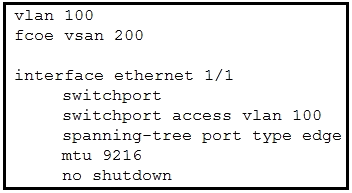
An attempt to bind the Ethernet interface to vFC fails. Which action resolves the issue?
Refer to the exhibit.
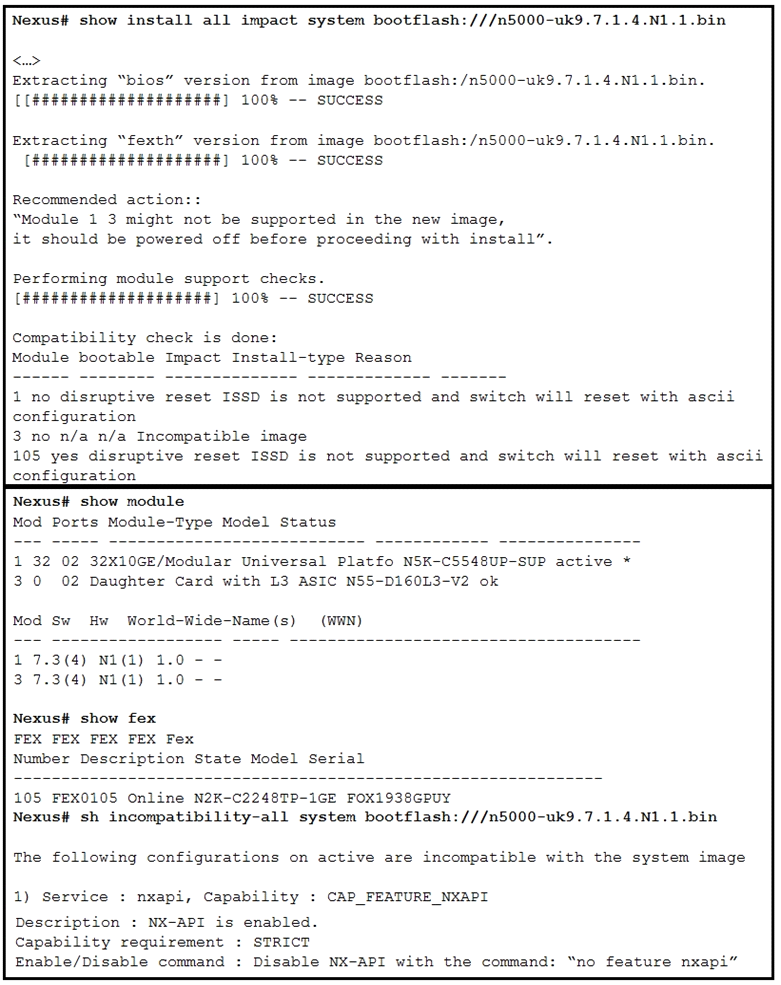
A switch is being downgraded to an earlier release because of a problem with the current release. After the switch is downgraded, it can no longer forward traffic. Which action resolves the issue?
When a switch cannot forward traffic after being downgraded to an earlier release:
Configuration incompatibility between software versions is a common cause of forwarding failure after downgrade.

