At ValidExamDumps, we consistently monitor updates to the Cisco 300-610 exam questions by Cisco. Whenever our team identifies changes in the exam questions, objectives, focus areas or requirements, We immediately update our exam questions for both PDF and online practice exams. This commitment ensures our customers always have access to the most current and accurate questions. By preparing with these up to date and 100% exam domain coverage questions, our customers can successfully pass the Cisco Designing Cisco Data Center Infrastructure exam on their first attempt without needing additional materials or study guides.
Other certification materials providers often include outdated or removed questions by Cisco in their 300-610 exam. These outdated questions lead to customers failing their Cisco Designing Cisco Data Center Infrastructure exam. In contrast, we ensure our questions bank includes only precise and up-to-date questions. Our main priority is your success in the Cisco 300-610 exam, not profiting from selling obsolete exam questions in PDF or Online Practice Test.
An engineer must interconnect customer data centers by using a 10-Gbps. unicast-only, Layer 3 circuit The requirement is to stretch the Layer 2 connection over the tunnel isolate STP traffic and create more than two million logical network segments Much solution meets these requirements?
An engineer must implement an iSCSI storage connectivity in the existing Cisco UCS environment. The environment is based on Cisco UCS -Series rack server, Cisco Nexus 1000V Series Switches, and VMware ESXi hosts. The implementation must meet these requirements:
Provide multipathing and high availability in the event of a critical path failure.
Be cost-effective and not require the purchase of new equipment.
Which two components must be selected to meet these requirements? (Choose two.)
To implement iSCSI storage connectivity meeting the requirements of multipathing, high availability, and cost-effectiveness:
This combination provides a complete iSCSI solution using existing resources.
An engineer must integrate Layer 4 to Layer 7 services within Cisco ACI Fabric. The main requirement is to have a single point of configuration for network elements and firewall policies.
Which action meets these requirements?
To integrate Layer 4-7 services within Cisco ACI Fabric with a single point of configuration, the solution is to deploy a service graph with a firewall device. This approach provides:
This eliminates the need for separate firewall configuration systems and provides a unified operational model.
Which two types of service profile templates does Cisco UCS support? (Choose two.)
Cisco UCS supports two types of service profile templates:
Initial Template - This template type is used as the basis for creating new service profiles. It defines the default configuration that will be applied to servers when they are provisioned. Initial templates serve as the starting point for service profile creation and can be customized during deployment.
Updating Template - This template type is used to push configuration changes to existing service profiles that were derived from the template. When an updating template is modified, those changes can be propagated to all associated service profiles, enabling consistent updates across multiple servers without manual individual configuration.
These two template types provide flexibility:
This dual-template approach allows organizations to scale deployment while maintaining configuration consistency across their infrastructure.
Refer to the exhibit.
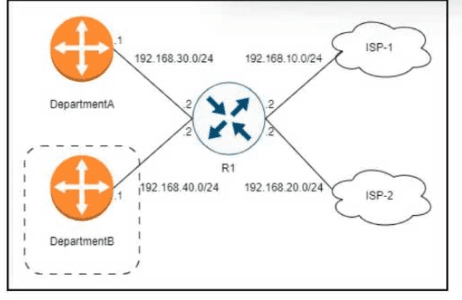
Refer to the exhibit. Router R1 provides connectivity for Department
VRF-Lite provides the required Layer 3 separation by creating independent routing and forwarding instances on R1. Cisco documents that each VRF maintains its own IPv4 and IPv6 routing tables and makes routing decisions independently. Interfaces facing Department A and Department B are assigned to their respective VRFs, so a route learned or configured in one department is not automatically available to the other. The Department B VRF can contain a single default route with next hop 192.168.20.1, forcing its external traffic toward ISP-2. Department A can retain its existing routing policy and ISP reachability without exposing those paths to Department B. An MPLS VPN is unnecessary because the requirement concerns local virtualization on one router, not a provider MPLS backbone. Separate VLANs create Layer 2 broadcast-domain separation, but an ACL tied only to ISP-1 does not provide the clean, independent routing contexts required and can become difficult to maintain as routes change. Running separate routing protocols in the same global routing table also fails to guarantee isolation because installed routes still enter a common RIB and FIB unless VRFs are used. VRF-Lite therefore supplies both deterministic ISP selection and structural separation. Any intentional communication between departments would require explicit route leaking or an external policy-controlled service, preserving the default isolation specified in the design. Cisco Nexus Layer 3 virtualization guide

