Free Cisco 300-515 Exam Actual Questions & Explanations

Last updated on: Jun 28, 2026
Author: Yuki Rivera (Cisco Service Provider Network Architect)

The Cisco 300-515 exam validates your ability to implement and manage service provider VPN solutions in enterprise and carrier networks. This exam is designed for network professionals pursuing the Cisco Certified Network Professional and Cisco Certified Network Professional Service Provider certifications. Success on this exam demonstrates hands-on competency in designing, configuring, and troubleshooting VPN architectures that support modern service delivery. This page provides a structured study roadmap covering the core exam topics and practical preparation strategies to help you build confidence and pass on your first attempt.

300-515 Exam Syllabus & Core Topics

Use this topic map to guide your study for Cisco 300-515 (Implementing Cisco Service Provider VPN Solutions) within the Cisco Certified Network Professional and Cisco Certified Network Professional Service Provider path.

  • VPN Architecture: Understand the design principles, reference models, and deployment patterns for service provider VPN solutions. You must be able to evaluate architectural tradeoffs, select appropriate VPN types for customer requirements, and plan scalable multi-tenant environments.
  • Layer 2 VPNs: Master Ethernet VPN (EVPN), Virtual Private LAN Service (VPLS), and point-to-point protocols. Configure and troubleshoot L2VPN services, interpret control plane signaling, and optimize forwarding performance in production networks.
  • Layer 3 VPNs: Implement Multiprotocol Label Switching (MPLS) VPN, BGP/MPLS IP VPN, and VRF-based routing. Configure route targets, manage route distribution, handle failover scenarios, and verify end-to-end connectivity across service provider backbones.
  • IPv6 VPNs: Deploy IPv6 in MPLS and BGP VPN environments, configure dual-stack services, and manage IPv6 address allocation and routing policies. Understand IPv6-specific security considerations and interoperability with legacy IPv4 infrastructure.

Question Formats & What They Test

The 300-515 exam uses multiple question types to assess both theoretical knowledge and practical problem-solving ability. Questions progress in difficulty and mirror real-world scenarios you will encounter in service provider operations.

  • Multiple choice: Test recall of VPN concepts, protocol behaviors, configuration syntax, and best practices. Questions focus on definitions, feature interactions, and key terminology across all four topic domains.
  • Scenario-based items: Present real-world customer requirements or network issues. You analyze symptoms, evaluate design options, and select the best solution for deployment, troubleshooting, or capacity planning.
  • Simulation-style questions: Require you to navigate Cisco device interfaces, configure VPN parameters, verify service status, and interpret output to solve operational problems under time pressure.

Questions are designed to reward both breadth of knowledge and depth of hands-on experience, with emphasis on practical decision-making in production environments.

Preparation Guidance

Effective preparation requires a structured study plan that maps exam topics to weekly learning goals and reinforces concepts through progressive practice. Allocate 4-6 weeks for thorough preparation, balancing conceptual study with hands-on labs and timed practice tests.

  • Divide the four core topics (VPN Architecture, Layer 2 VPNs, Layer 3 VPNs, IPv6 VPNs) into weekly focus areas. Spend at least one week on each domain, then dedicate the final week to integrated review and weak-area remediation.
  • Complete practice question sets after each topic block. Review detailed explanations for both correct and incorrect answers to identify knowledge gaps and reinforce reasoning patterns.
  • Build conceptual bridges by studying how VPN Architecture principles apply to L2 and L3 implementations, and how IPv6 extends each service model. This interconnected understanding improves retention and exam performance.
  • Run a timed practice test under exam conditions (90 minutes, no breaks) two weeks before your scheduled exam date. Use results to prioritize final review and build pacing confidence.

Explore other Cisco certifications: view all Cisco exams.

Get the PDF & Practice Test

Strengthen your preparation with up-to-date resources from validexamdumps.com. These materials align to 300-515 and cover practical scenarios with clear explanations.

  • Q&A PDF with explanations: topic-mapped questions that clarify why correct options are right and others aren't.
  • Practice Test: realistic items, timed/untimed modes, progress tracking, and detailed review.
  • Focused coverage: aligned to VPN Architecture, Layer 2 VPNs, Layer 3 VPNs, and IPv6 VPNs so you study what matters most.
  • Regular reviews: content refreshes that reflect syllabus and product changes.

Visit the exam page to download the PDF, Online Practice Test, or get a bundle discount for both formats: Implementing Cisco Service Provider VPN Solutions.

Frequently Asked Questions

Which topics carry the most weight on the 300-515 exam?

Layer 3 VPNs and VPN Architecture typically account for 40-50% of exam questions, reflecting their importance in service provider operations. Layer 2 VPNs and IPv6 VPNs each represent 20-30% of the exam. Prioritize MPLS/BGP VPN fundamentals and architectural design patterns in your early study weeks.

How do the four core topics connect in real service provider workflows?

VPN Architecture provides the framework for all implementations. Layer 2 and Layer 3 VPNs are the primary service types deployed by providers, often running in parallel to serve different customer segments. IPv6 VPNs extend both L2 and L3 models as networks transition to dual-stack. Understanding these dependencies helps you design end-to-end solutions and troubleshoot cross-layer issues.

How much hands-on lab experience is needed to pass?

Hands-on experience significantly improves retention and confidence. Aim for at least 20-30 hours of lab work covering BGP/MPLS VPN configuration, EVPN setup, route target manipulation, and IPv6 VPN deployment. If you lack access to physical hardware, use Cisco's modeling tools or GNS3 to simulate realistic topologies and practice configuration under time constraints.

What are the most common mistakes that cost exam points?

Candidates often confuse route target import/export semantics, misunderstand EVPN control plane signaling, or overlook IPv6-specific routing policy requirements. Another frequent error is selecting the wrong VPN type for a given customer requirement without considering scalability or service model constraints. Careful scenario reading and systematic elimination of incorrect answers reduce these mistakes.

What is an effective study strategy for the final week before the exam?

In the final week, focus on timed practice tests and targeted review of weak areas identified in earlier practice attempts. Avoid learning new material; instead, reinforce core concepts through scenario-based questions and configuration walkthroughs. Get adequate sleep and maintain a calm mindset to optimize recall and decision-making during the actual exam.

Question No. 1

Refer to the exhibit.

Which result occurs when PE1 learns a new MAC address and all three PEs are enabled with EVPN native?

Show Answer Hide Answer
Question No. 2

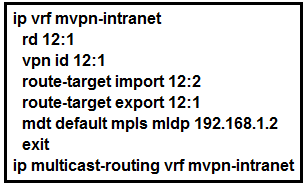
Exhibit:

What is the effect of this configuration?

Show Answer Hide Answer
Correct Answer: B

Question No. 3

Which kind of traffic is supported in an MVPN Extranet?

Show Answer Hide Answer
Question No. 4

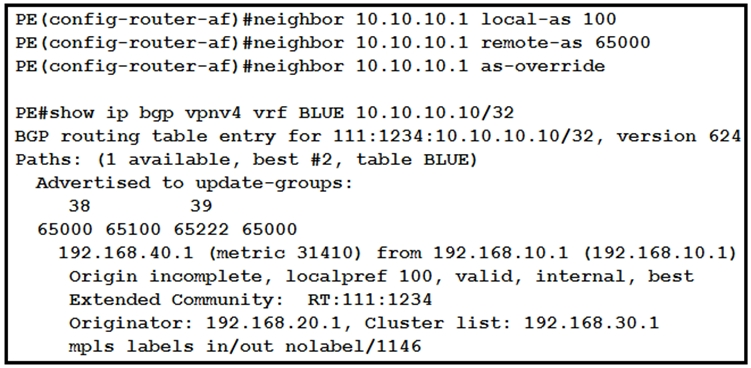
Refer to the exhibit.

While provisioning a new BGP session between the PE and CE router, you issue the as- override command. Which statement describes modification of the prefix before being sent to the CE router (10.10.10.1)?

Show Answer Hide Answer
Correct Answer: D

Question No. 5

How does Layer 3 VPN traffic traverse an ISP network?

Show Answer Hide Answer
Correct Answer: C