At ValidExamDumps, we consistently monitor updates to the Cisco 300-425 exam questions by Cisco. Whenever our team identifies changes in the exam questions,exam objectives, exam focus areas or in exam requirements, We immediately update our exam questions for both PDF and online practice exams. This commitment ensures our customers always have access to the most current and accurate questions. By preparing with these actual questions, our customers can successfully pass the Cisco Designing Cisco Enterprise Wireless Networks exam on their first attempt without needing additional materials or study guides.
Other certification materials providers often include outdated or removed questions by Cisco in their Cisco 300-425 exam. These outdated questions lead to customers failing their Cisco Designing Cisco Enterprise Wireless Networks exam. In contrast, we ensure our questions bank includes only precise and up-to-date questions, guaranteeing their presence in your actual exam. Our main priority is your success in the Cisco 300-425 exam, not profiting from selling obsolete exam questions in PDF or Online Practice Test.
An engineer must optimize client roaming after noticing that clients in the environment are not roaming as expected. Upon reviewing an over- the-air packet capture, the engineer sees that the AP is sending a BSS Transition Management query to the client, which causes it to roam.
The disassociation imminent feature is not enabled on the WLAN. What is the cause of the issue?
Optimized roaming is a feature that helps manage the client's roaming behavior by disassociating clients with a signal strength below a predefined threshold. This feature is designed to prevent clients from sticking to an AP with poor connectivity, which can lead to suboptimal performance. If the BSS Transition Management query is causing the client to roam and the disassociation imminent feature is not enabled, it indicates that optimized roaming is likely enabled, prompting the client to seek a better AP connection.
An engineer is trying to configure the APs installed in a new auditorium to use 40 MHz channels with high data rates and lower TX power. The APs in the building hallway must use lower-density design settings configured for the rest of the building. Which two configurations achieve this design? (Choose two.)
AP groups allow the engineer to apply different policies for APs in the auditorium versus those in the hallway. RRM (Radio Resource Management) can dynamically adjust the TX power and channel settings to optimize the wireless coverage and capacity.
Refer to the exhibit.
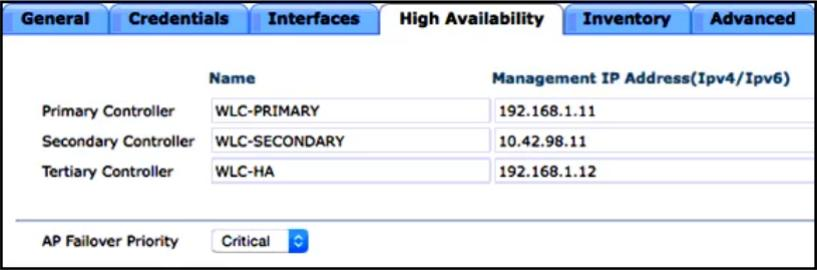
A network engineer has identified that during a recent controller failure, several APs failed over to the tertiary controller instead of the secondary controller. The configuration from one of the APs is provided. Which design consideration led to the issue?
The issue where APs failed over to the tertiary controller instead of the secondary controller during a controller failure is likely due to the secondary controller being at capacity. When a controller reaches its maximum capacity, it cannot accept any additional APs, causing them to failover to the next available controller in the high availability configuration.
An enterprise network administrator is asked to set up an experimental WLAN for a collaboration project with a local service provider. The WLAN must be anchored to a WLC in the service provider data center using legacy mobility mode. After the configurations are completed on the WLCs and the firewalls in the path, the data path mobility tunnel is failing to come up. What should be performed by the administrator to debug the issue?
https://www.cisco.com/c/en/us/support/docs/wireless/4400-series-wireless-lan-controllers/107458-wga-faq.html
Community vote distribution
A customer Wi-Fi deployment is experiencing the sticky client problem and must enable the optimized roaming feature. The wireless clients have valid security credentials for an SSID and can see an AP that offers that SSID to join. What must be configured to enhance roaming?
To address the sticky client problem, setting an RSSI (Received Signal Strength Indicator) threshold can help. This configuration will prompt clients to roam to a better AP when their signal strength falls below the set threshold, thus enhancing the roaming experience and ensuring clients are connected to the AP with the strongest signal available.

