Key details for this exam, checked against the published exam outline
Each question shows the correct answer and an explanation of why it is right
Twelve hours have passed since you received the telephone call concerning the oil spillage.
You receive the following telephone call from William Seaton, Director of Finance:
''The press has got a hold of the story about the oil leak. Our share price has taken a major hit. Indeed, Slide's market capitalisation has fallen by a third since the stock exchange opened for business. There is a lot of loose talk in the press about the knock-on effect of this crisis for Slide. It has not escaped anybody's notice that there are news teams showing injured wildlife. There is also a great deal of footage being broadcast on the other sites around the world where we are revitalising oil wells using the same technology that was in use at AZ40.
Our experts have only just arrived at the spillage site. While they were on the corporate jet they emailed their initial thoughts, based on their understanding of what went wrong. Our engineers anticipate a major operation to block the leak by pumping cement into the bore hole at a low pressure. This will be expensive, but the cost will be less than one tenth of the reduction in our market capitalisation.
I need an email from you:
Firstly, I need a clear explanation of the key risks that Slide now faces because of this crisis. I am only interested in those with a high risk and high consequence and I need you to justify those classifications because the Board will need to prioritise its responses.
Secondly, two related issues: I need you to explain why Slide's share price has fallen to such an extent AND to recommend, with reasons, whether we should release our costings of the repair scheme at this time.
It goes without saying that I need this urgently.''
The formal merger with Darrell has been negotiated and the legal formalities have been completed. The two company management teams are working on the integration of the two businesses.
You receive an email from Peter Sorchi, the Chief Executive of the merged company:
From: Peter Sorchi, Chief Executive Officer
To: Senior Finance Manager
Subject: Integration of IT and treasury
Hi,
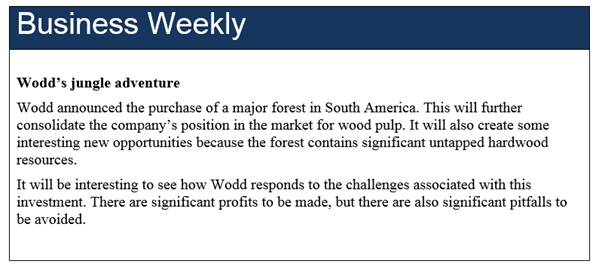
I need you to advise me on a couple of matters. The attached press clipping shows how sensitive this is.
We need to integrate the IT and treasury functions of the former Wodd and Darrell. I thought that it would be a simple matter of identifying the common ground and slimming down both companies' departments to cover the new entity, but I have the heads of both IT and treasury from each company arguing that their approaches are better for the merged group and that they should take the lead.
Wodd's Treasurer claims to be an expert in natural hedging of currency risks and Darrell's argues that her department was highly successful because it makes excellent use of derivatives for hedging. Both agree only on the fact that they cannot work together. I am afraid that I have to agree with them on that and the Board will have the difficult decision of choosing between them.
I have the opposite problem with the IT function. The two Heads of IT are excited to be able to combine their databases and to develop their respective interests in Big Dat
a. They claim that we should retain all of the professional staff in both departments and possibly even expand the merged IT Department beyond that. Given the rationalisation in all of our other functions, I do not think that we can agree to that, but I would hate to throw away a worthwhile opportunity.
Please give me your thoughts on the following:
What approach to hedging is more likely to meet our needs: natural hedging or heavy use of derivatives?
Ignoring hedging, what other factors should we consider in deciding between the two treasurers?
Are the two heads of IT likely to be correct in arguing that we need to retain all existing IT staff in order to exploit synergies in data, particularly opportunities to leverage Big Data?
What would the challenges be in motivating them to reduce their joint staffing levels and how might we deal with these?
Peter
Wodd's Chairman enters your office:
"I am glad I caught you, I am looking for some advice, but I do not wish to involve your boss at this stage, or any of the other executive directors.
I have been approached by Darrell's Chairman concerning the possibility of a merger between our two companies. I was a little surprised because it has apparently, according to a press article, been in talks with at least one of our competitors and I suspect that it is keen to merge with any large company that can offer some synergy. I understand that Tabel, another major forestry company, has already rejected its proposal.
I happen to know that Darrell has invested a little too heavily in its new MDF factory. It is state of the art, but it has to operate at close to full capacity in order to be economic and Darrell just hasn't got sufficient forestry resources to keep the factory operating at full volume without destroying its own forests.
We are attractive to merge with because we own large forests that can sustain Darrell's needs. We don't manufacture MDF ourselves, but we have lots of experience of supplying this market with raw material. We would divert lots of this output to Darrell's factory. Darrell believes that it would be possible to dominate the MDF industry if it merged with a company such as ourselves. The fact that we were quite liquid at the end of last year also helps, because I understand that Darrell is having a few cash flow problems.
Its Chairman proposes a full merger. This will be achieved by the creation of a new parent company which will acquire existing equity in both companies through an exchange of shares. He and I will head a special nomination committee to select the most suitable Board for the new company and then I will step down from the Board while he continues as Chairman of the new company.
Needless to say, this is all highly confidential.
Do you think that it sounds as if there are potential and achievable synergies between Wodd and Darrell?
Would you regard it as a gross ethical breach to keep this conversation just between the two of us for the time being, without warning your boss, until I have had the chance to negotiate further with my counterpart at Darrell?"
Reference Material:

You have received the following email from Marcus Svenson, Finance Director:
From: Marcus Svenson, Finance Director
To: Senior Finance Manager
Subject: Investment opportunity
Hi,
The Board is considering an investment opportunity to buy a forest in Bravador, a country in South Americ
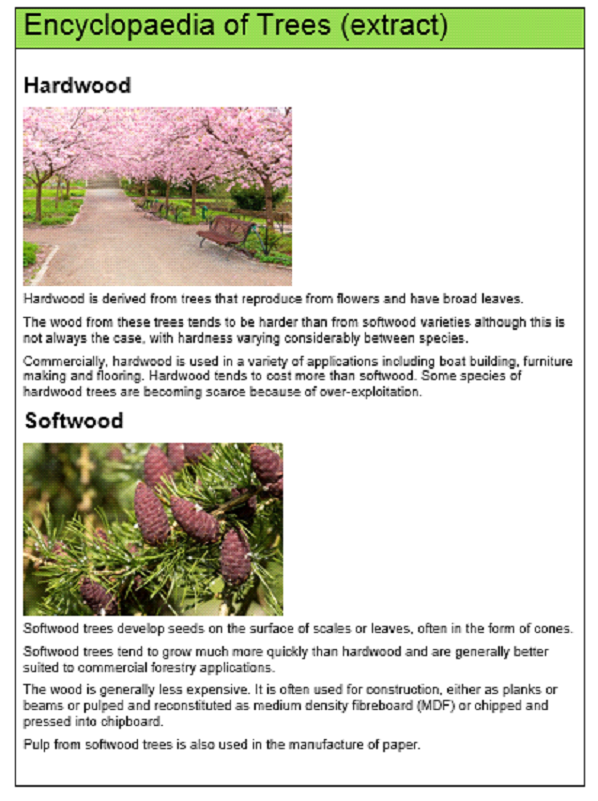
a. This will be a major expansion and will also enable us to diversify into new lines. For example, the forest contains lots of hardwood varieties that we could sell to companies in the double glazing industry or to furniture manufacturers. I downloaded the attached extract from an online encyclopaedia for your information.
The forest that we are planning to buy has not been used for commercial purposes until now. The land belonged to the Government for many years and it has been left to grow naturally. The Government is now keen to sell the land and has agreed that it may be used for commercial forestry purposes.
This investment will enable us to increase our output of softwoods by up to 20% per year, in addition to enabling us to enter the hardwood market.
I need two things from you. I need you to recommend a suitable approach to managing our relationship with the Bravadorian Government. I also need you to identify and explain the political risks that will remain even if we succeed in creating a sound relationship with the Government.
Marcus
Reference Material:
Peter Sorchi, Wodd's Chief Executive has stopped you in the corridor:
"We signed a memorandum of understanding with the Bravadorian Government last night. Effectively, we are now the new owners of a forest in a new continent for us. It has already made it onto the business pages in the press.
Once the formalities are completed, we will be entering into new commercial territory. Our surveyors have looked at the first area that we intend to develop and there is a lot more hardwood than we first expected. That is good news in a way because it can be sold at a premium, but we don't have any experience of selling hardwood and we are hardly going to pulp it for MDF or paper. I need you to identify the changes that we will have to make and to recommend how best to manage them.
The funding arrangements are still being worked out. Bravador's banks are not in a position to fund a transaction of this size and none of the other banks that we have approached are prepared to lend to us. We will need to raise additional equity. I realise that we would normally make a rights issue, but I think that it would be simpler and cheaper to suspend the dividend for a year, which would cover most of the purchase price in itself. Please advise me on the advantages and disadvantages of doing that.
It would be ideal if you could let me have a briefing paper on both of these matters urgently."
Reference Material:
You have received the following email from Peter Sorchi, CEO:
From: Peter Sorchi, Chief Executive Officer
To: Senior Finance Manager
Fwd: Tax avoidance article
Hi,
I am forwarding you an email from a journalist. It came in via our press office, who passed it up the management chain and it ended up in my inbox.
Some of the basic facts stated in the draft article are correct:
We do have arrangements in place with leading tax advisers for referrals of potential clients. We pay a commission for all such referrals, which the tax adviser is required to disclose to the client.
Barry Crauder has been one of our largest clients for many years. He owns significant forested land and we manage that in return for our usual fee.
We do not offer tax advice, or promote forestry as a tax-efficient investment. We simply offer a forestry management service as a paid service.
I would like you to address the following issues and I need your reply as a matter of some urgency.
Could we be accused of behaving unethically with respect to this aspect of our forestry management service?
Please draft a response that we can submit to Sonia Jones. Please also give an explanation for the Board as to how you will address the fact that the draft newspaper article clearly makes us appear to be unethical. We will consider your draft and related comments at a meeting this afternoon, before submitting anything.
Peter
To: Press Office, Wodd
From: Sonia Jones, reporter, Daily Gazette
Re: Tax avoidance article
I am seeking a response from Wodd concerning the activities of the celebrity Barry Crauder. We have established that Mr Crauder has been investing heavily in forestry in order to avoid paying tax on the considerable wealth that he has amassed from his show business career.
We believe that a significant part of this story is the relationship between forestry companies such as Wodd and professional tax advisers. When researching this story I posed as a wealthy investor and approached several firms that specialise in offering tax avoidance advice to high net worth individuals. Four of the firms whom I approached recommended a forestry scheme and specifically recommended Wodd to manage it for me. I believe that Wodd has a close relationship with these firms and possibly others.
I have attached a draft of my story. I have sufficient evidence to support every fact stated. I am writing in order to give Wodd the opportunity to respond if it wishes to do so, although the story will run regardless. I will require your comment within 48 hours, otherwise, I will run the story as it stands.
Sonia Jones
Chief reporter, Daily Gazette
From: Abdhulla Al- Waihabi, Regional Manager -- Middle East -- Slide
To: William Seaton, Director of Finance
Subject: Press article
Hi William,
I have just had a telephone call from a journalist at Business News to ask for a comment on a story that it plans to run. As you know, we purchased oil wells in the AZ40 field last year in order to bring them back to full production. We got the wells for a good price because the previous owner was struggling to maintain oil pressure and it appeared that the recoverable reserves in that field were close to exhaustion. Our experts worked out a plan to drill a hole and pump water into the well to force more oil to the surface. That is a standard industry technique. Our geologists are the best in the industry and so we are better than most at bringing wells back on stream.
It now appears that we are being blamed for an environmental catastrophe. Our pumping station is only one kilometre from the sea and there are reports of oil coming to the surface along the coast close to where we are operating. We have only just started operations and there are fears that we have ruptured a rock formation with our high pressure pumping.
I have ordered an immediate halt to all pumping activity, but the oil could continue to bubble up for years. The coastal area has some important coral reefs and there are fishermen who depend on shellfish that can be found there.
I told the journalist that she would have to wait for a response from Slide's Board. Business News is a European newspaper, so any comment from you will carry more weight anyway.
I am sorry to be the bearer of such bad news.
Abdhulla
Exam domains verified against: Official CIMA CIMAPRO19-CS3-1 exam guide, last checked October 2026.
Understand how to analyze internal and external business environments using frameworks such as PESTEL, SWOT and Porter's Five Forces. Assess organizational resources, capabilities and core competencies to identify competitive positioning and benchmark performance against industry standards.
Sample question from this domain above: Q4
Evaluate strategic options using cost-benefit analysis and risk assessment techniques. Apply strategic planning models such as Ansoff's Matrix and the BCG Matrix to develop growth strategies including market penetration, product development, market development and diversification.
Translate strategic plans into actionable initiatives and ensure their effective execution. Apply change management techniques to handle organizational change and allocate resources effectively to support strategic goals and monitor progress.
Sample question from this domain above: Q3
Monitor and assess the effectiveness of strategic plans using performance indicators and metrics. Conduct regular strategic reviews, manage risks associated with strategic plans and apply continuous improvement techniques to enhance performance.
Apply principles of corporate governance to strategic decision-making and address ethical issues in strategic management. Ensure regulatory compliance and incorporate sustainability and social responsibility considerations into strategic decisions.
Common questions about the exam itself

