At ValidExamDumps, we consistently monitor updates to the Blue Prism ASD01 exam questions by Blue Prism. Whenever our team identifies changes in the exam questions, objectives, focus areas or requirements, We immediately update our exam questions for both PDF and online practice exams. This commitment ensures our customers always have access to the most current and accurate questions. By preparing with these up to date and 100% exam domain coverage questions, our customers can successfully pass the Blue Prism Designing Blue Prism Process Solutions exam on their first attempt without needing additional materials or study guides.
Other certification materials providers often include outdated or removed questions by Blue Prism in their ASD01 exam. These outdated questions lead to customers failing their Blue Prism Designing Blue Prism Process Solutions exam. In contrast, we ensure our questions bank includes only precise and up-to-date questions. Our main priority is your success in the Blue Prism ASD01 exam, not profiting from selling obsolete exam questions in PDF or Online Practice Test.
ProSafe credil reference agency retrieves data from bank and other credit providers where customers have missed payments or gone into default. The data is very sensitive and fed directly into a Blue Prism work queue via a web service. Blue Prism process must process the data within 4 hours. The Blue Prism solution runs continuously and each case takes approximately 30 seconds to process. It is expected that an average of 10,000 cases per day will be required and up to 10 Blue Prism robots are available. The Blue Prism solution is shown below:
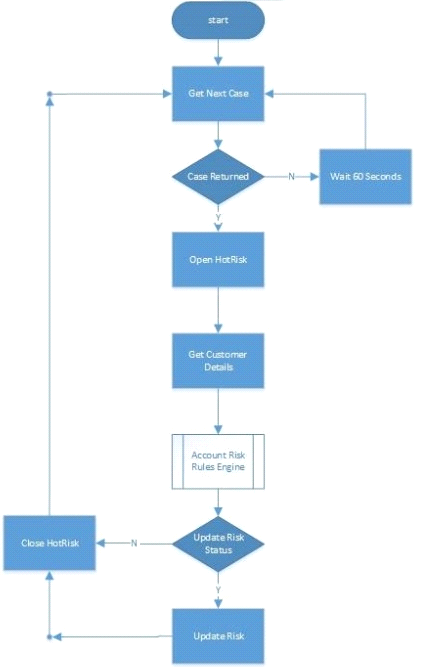
For each case the process will access the customer account in the HotRisk system and, where an account exists, harvest the data which will be fed along with the Work Queue data into a rules engine. The rules engine is a Blue Prism process that does not interact with any target system. It merely consumes data and. via a complicated series of decision and choice stages, determines the new customer risk factor.
There is to be no scheduler used. Instead the Process Controllers who work in shifts to provide 24 hour support will stop and start process instances in line with Work Queue volumes.
As a Blue Prism process solution designer, who is reviewing the solution, which of the following would concern you? (select 3 responses)
VivaBank have an account closure process that can take up to three days to close an account. All requests within the bank's core system to close an account take place overnight during batch processing. There are two scenarios:
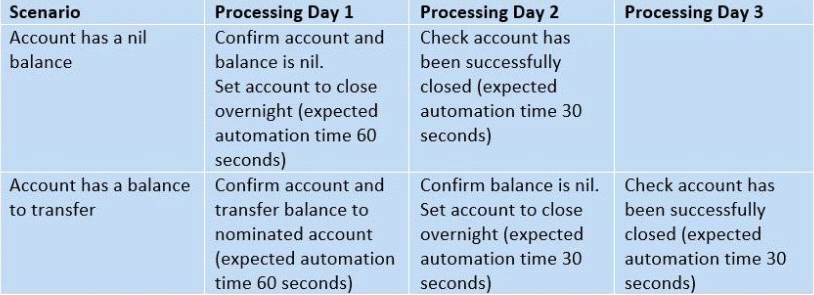
The timings relate to the expected automation time.
All requests will arrive in a Blue Prism work queue from multiple channels using either web services or other Blue Prism processes.
The following detail from the Functional Requirement Questionnaire must be considered:
* Cases must be processed on the same day if they come in between 08 00 and 22:00 Monday to Friday
* Exception cases are to be emailed to the manual team during processing as and when they occur.
* It is expected that up to 200 cases can be expected per day.
The Blue Prism solution consists of four processes and four Blue Prism Work Queues.
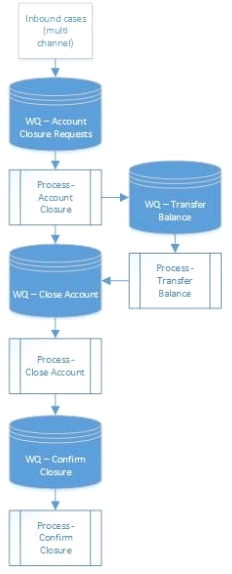
Cases come into the Account Closures Work Queue and are processed by the Account Closure process which determines if they are ^Nil Balance" or "Balance to Transfer" scenarios. Before adding the case to the relevant work queue, a check is made to see if an identical key has been added to the work queue today. If so the case is not added.
The Transfer Balance process works its queue and, for each successfully processed case, adds case to the Close Account queue.
The Close Account process works its queue and. for each successfully processed case, adds a case to the Confirm Closure queue with the case deferred to 08:00 the next day.
The Confirm Closure process completes the sequence by confirming that the account is finally closed.
A scheduler has been created to start all four processes at 08:00. Each process shall be configured to finish accordingly:

Please select from the statements below the ones you consider to be correct (select 2 responses
Consider the following high-level design:
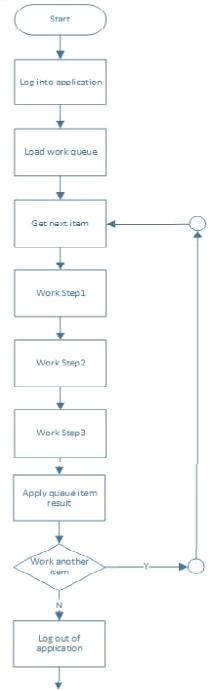
The application concerned is prone to being sluggish or even unresponsive at times. As the solution designer you should anticipate that there will be system exceptions and that after an exception case the application might not be in arNdea1 state. What should you do? (select 3 responses).
Consider the following steps for a theoretical manual process
* Check in input folder for any new files.
* If there are no files check again later as files can arrive anytime, and there is no limit to the number of files that may come.
* Open the next available file.
* Take the first case
* Start System X and find the case details.
* If the case can't be found., move to the next one.
* After finding the case in System X. fetch additional case details from System Y.
* Again if the case can't be found, move to the next one.
* Analyse all the data to see if System Z should be updated
* If the data does not meet the requirements, add notes indicating this to Systems X and Y and move to the next case
* If the data does meet the requirements, update the case in System Z
* Add notes to Systems X and Y and move to the next case.
* At the end of the file, go back and look for another
* Stop checking for new files at 16:00 and finish any remaining cases.
* When all work is complete create a report of the day's exception cases.
* Close down Systems X, Y and Z.
If it is imperative that notes are applied to System X and Y, regardless of whether System 2 is updated or not, what could the process do? (select 2 responses)
SanQuest Bank's call centre regularly receives requests from customers for the exact amount required to clear their loan This is a complicated calculation that is prone to human error. The bank has decided to use Blue Prism to perform the calculation and is considering amending its front end system OneBase to allow a user to click a button to request a Loan Consolidation Amount. They plan to communicate with Blue Prism using web services Consider the two proposed designs:
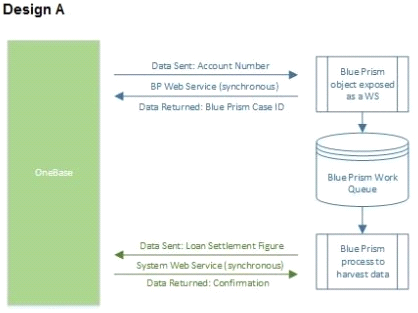
Here a Blue Prism object is exposed as a web service OneBase calls this service providing the account number The Blue Prism object add the case to a work queue and then returns the Case ID to complete the web service call
A Blue Prism process works the queue and harvests the data required to perform the calculation. The same Blue Prism process calls a OneBase web service and provides the loan settlement figure. OneBase completes the web service call by returning a success flag.
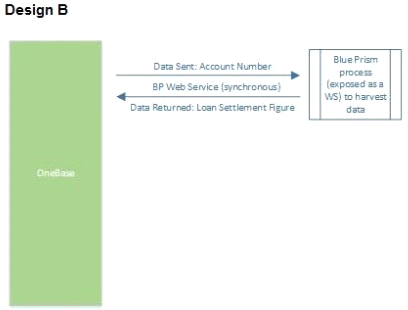
Here the Blue Process that harvests the data is exposed a web service with the loan settlement figure as an output. OneBase calls the web service and provides the account number. The Blue Prism process harvests the data and completes the web service call by providing the loan settlement figure.
Considering Blue Prism best practice which of the following statements is correct?

