At ValidExamDumps, we consistently monitor updates to the BCS RE18 exam questions by BCS. Whenever our team identifies changes in the exam questions,exam objectives, exam focus areas or in exam requirements, We immediately update our exam questions for both PDF and online practice exams. This commitment ensures our customers always have access to the most current and accurate questions. By preparing with these actual questions, our customers can successfully pass the BCS Practitioner Certificate in Requirements Engineering 2018 exam on their first attempt without needing additional materials or study guides.
Other certification materials providers often include outdated or removed questions by BCS in their BCS RE18 exam. These outdated questions lead to customers failing their BCS Practitioner Certificate in Requirements Engineering 2018 exam. In contrast, we ensure our questions bank includes only precise and up-to-date questions, guaranteeing their presence in your actual exam. Our main priority is your success in the BCS RE18 exam, not profiting from selling obsolete exam questions in PDF or Online Practice Test.
Make Me A Star Productions runs an annual talent competition for aspiring amateur singers.
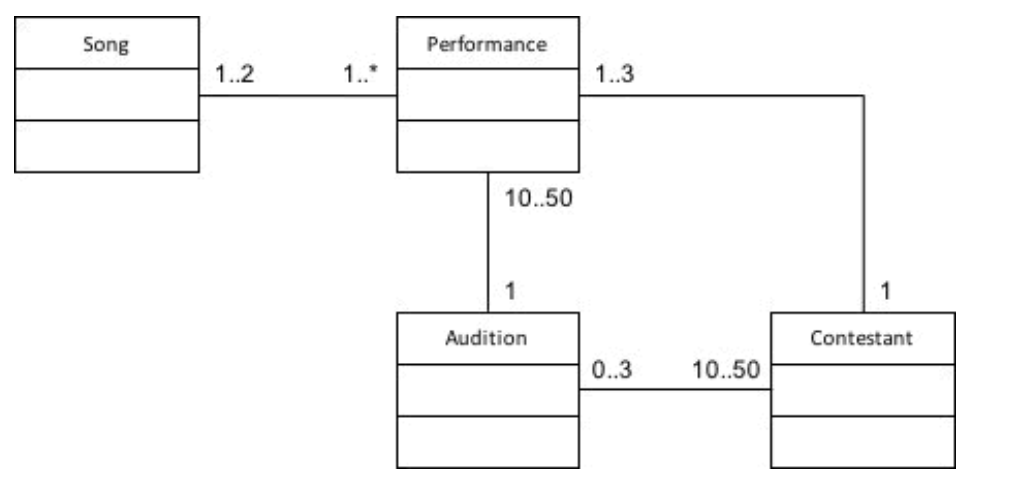
Four business rules have been identified:
1) A contestant is allowed to sing 1 or 2 songs in a performance.
2) An audition may be attended by up to 50 contestants.
3) A contestant is always given an audition.
4) A song can only be used in one performance.
Which of these business rule(s) can be found to be correctly represented in the class diagram?
A business analyst is in the process of completing the requirements document for a project. She has made the following 'to-do' list of actions to help keep track of her work:
1. Need to amend the description of the scope of the project.
2. Need to record the terminology used throughout the document.
3. Need to add the use cases and the as-is business process diagrams.
When she completes all of these actions, which requirements document sections will not have been updated?
Isamu is a business analyst working on a project. Unfortunately, it is not progressing as hoped or planned.
He has identified that the main issues with the users on the project are:
1) They manage complex processes and they do not seem to be able to articulate their needs.
2) They claim they cannot engage in requirements elicitation as they simply do not know what is possible.
Which elicitation technique would best address both these issues?
A project, which was initiated several months ago, has been impacted by the following changes:
1. An organizational restructure has altered the responsibilities of the stakeholders.
2. A new chief executive has been appointed, who has new ideas regarding the immediate focus of the project.
Which of the following attributes in a requirements catalogue entry would need to be updated to reflect these changes?
A business analyst working on a project has identified:
3 requirements for which there is a workaround and the users can live without;
2 requirements that the users can live without for now;
15 requirements which, if not delivered, will make the solution unworkable or useless.
When these requirements are prioritized using MoSCoW, which of the following categories will not be
used?

