BCS MBP18 Practice Exam Questions & Answers
6 Free Questions
· Last reviewed: September 18, 2026
· Prepared & Reviewed by the ValidExamDumps Editorial Team
Exam Facts
BCS MBP18 Exam Details
Key details for this exam, checked against the published exam outline
40
Practice Questions (Our Bank)
60 minutes
Exam Duration
GBP 264 (United Kingdom, including VAT)
Official Exam Fee
- Exam Code
- MBP18
- Full Name
- BCS Practitioner Certificate in Modelling Business Processes
- Issuing Body
- BCS, The Chartered Institute for IT
- Question Format (Our Bank)
- Multiple Choice
- Delivery
- Online proctored, at Pearson VUE test centre, or written format through approved training providers
- Eligibility
- Candidates should have practical experience in business analysis. no formal prerequisites required
Practice Questions
Free MBP18 Practice Questions
Each question shows the correct answer and an explanation of why it is right
VA
ValidExamDumps Editorial Team
Every question and its answer is checked by our MBP18 exam
preparation team, who also write the explanation shown with each one.
How we research and review these pages
Freddie's Sandwich Shop makes sandwiches to order, using the finest locally sourced ingredients. Freddie gets his bread from Country Bakes and the fillings for his sandwiches from Belle View Farms. Freddie's local approach has proved popular and many people now get their lunch from his shop. rather than from a branch of Wholegram Foods, which used to be the town's most popular sandwich shop.
Freddie is expanding his business to provide catering for local organisations and has just won a contract to provide sandwich lunches for UK Systems Limited, the local headquarters of a highly successful computer company. However, Freddie is worried about the poor wheat harvest and the effect this might have on the cost of his bread. He has also heard that UK Systems Limited has lost a valuable contract to an overseas competitor
In Harmon's organisational model, which of the following would provide inputs to internal processes?
Correct Answer:
D
Explanation
When passenger numbers increase significantly, the airport needs to handle more people flowing through the same physical spaces and processes. The mention of needing more staff specifically at check-in, security, and baggage handling points to bottlenecks - the points where passenger flow slows down because resources cannot keep pace with demand. Bottlenecks are capacity constraints that limit throughput. The other options like resource availability or process redesign are less directly addressed by simply adding staff to existing areas.
A record company is implementing a new system to replace an existing legacy system. The project has challenging as the new system must be implemented before support for the existing system is withdrawn. The business users have been involved throughout the project and their confidence in the new system is high.
Which implementation approach is the LEAST appropriate in this situation?
Correct Answer:
C
Explanation
The task description lists the standard steps a user follows when withdrawing cash from an ATM. Step 8, collecting the printed receipt, is an optional step because the user may choose not to take it. Most ATM processes include the option to print a receipt but do not require it. The other options relate to core steps that must happen for the transaction to work. This question tests understanding of how to document task steps and recognize which actions are mandatory versus optional within a process.
Furlow and Hall is an interior decorating business. Specializing in high-quality handmade soft furnishings and a best spoke design service. The business uses a small number of highly skilled craftspeople to make its products using traditional techniques.
Mrs Tieback, who sews the curtains for Furlow and Hall, is retiring later this year. Her local council has discovered that she has a workshop at her home and has informed her she is liable for business rates. This will lead to increased costs and so it is no longer economically viable for her to continue working.
Where would Mrs Tieback be shown on an organisational model of Furlow and Hall?
A)
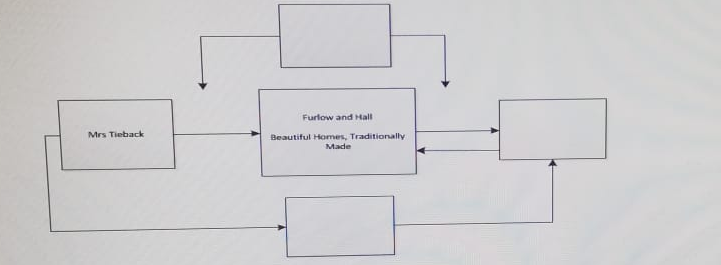
B)
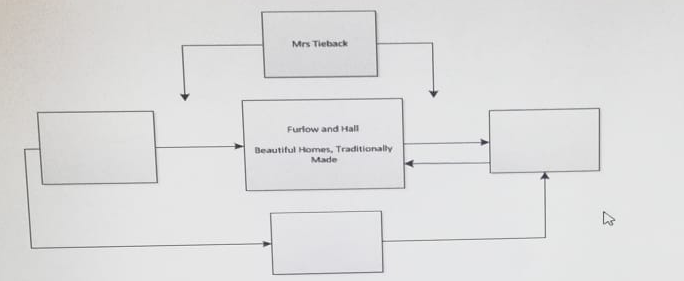
C)
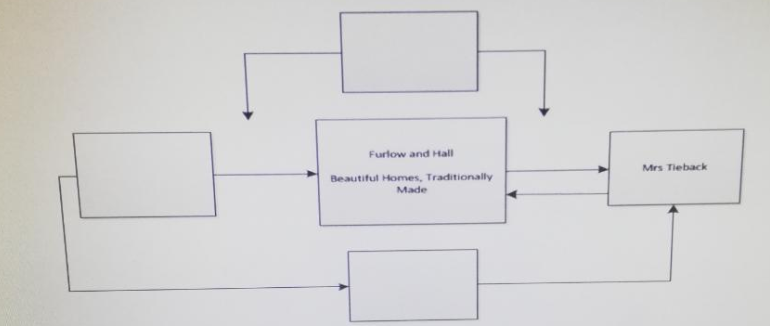
D)
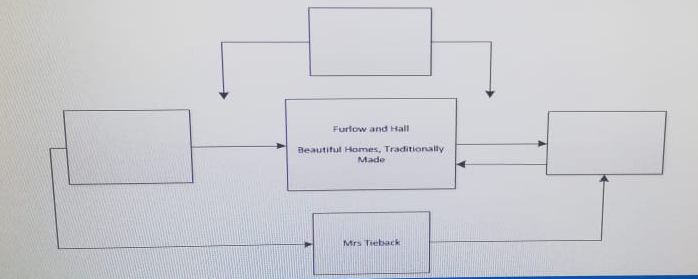
Correct Answer:
D
Explanation
ACOMP needs to adjust internal processes quickly across multiple markets. Harmon's organizational model helps businesses understand and visualize how processes connect to organizational structure and strategy at the enterprise level. This high-level perspective allows managers to see where changes are needed and how different parts of the business relate to each other. The model supports strategic thinking about process adaptation. The other options would not directly help the company understand its overall business structure and process relationships in a way that enables rapid adjustment.
The owner of a shop is taking a telephone order from a customer for a new vacuum cleaner. He needs to take and confirm customer details in this ordering process. As part of this, he enters the customer details onto a system.
What does the entry of the customer's name, address and contact number represent?
Correct Answer:
A
Explanation
The question asks for a measure that includes both internal and external performance indicators. Average duration of a call is an internal measure - it tells the call center how efficiently its own operations run. The actual number of calls answered per hour is also internal, measuring operator productivity. However, the correct answer combines these with how many calls need escalation, which reflects external customer satisfaction and service quality expectations. The contractual requirements about answering speed and call volumes directly link to external customer expectations, making this answer include both dimensions.
What is NOT clear from the following fragment of a business process model?
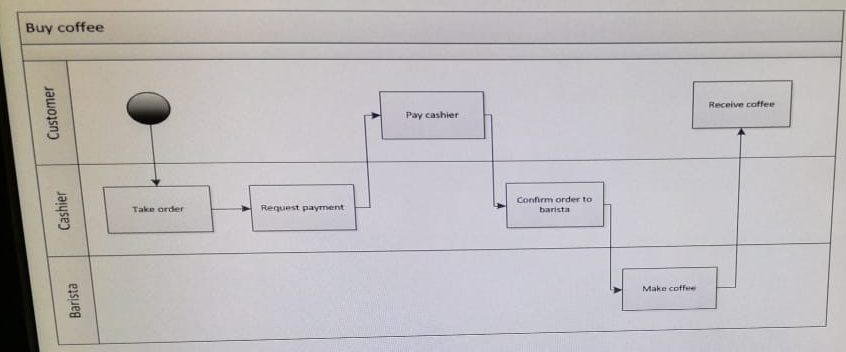
Correct Answer:
D
Question 6
A village clerk receives bookings for the use of the village hall for events such as weddings and parties. Although the village hall has a website, bookings have to be made in an email request from a potential customer to the village clerk, giving the dates and times required. The event name is ''Email
Correct Answer:
C
Full Access
Get the complete MBP18 question set
- 40 questions covering all exam domains
- Correct answers with explanations, like the free questions above
- PDF and online practice test
- 90 days of free updates
Domain 1: 1. The Context for Business Processing Modelling
15%
Understand why organisations model business processes and the benefits that process documentation brings to strategy. Learn the three levels of the business process hierarchy and recognise the importance of viewing an organisation through its processes rather than its functional structure.
Domain 2: 2. Modelling at the Enterprise Level
15%
Interpret how organisational models represent business processes and support delivery of value. Understand how process models at the enterprise level connect to overall strategy and business objectives.
Sample question from this domain above:
Q3
Domain 3: 3. Modelling at the Event-Response Level
30%
Learn to interpret and construct business process models using standard notation. Distinguish between different types of business events, understand task representation, and measure process performance against both internal measures and customer expectations.
Sample questions from this domain above:
Q4Q5
Domain 4: 4. Modelling at the Actor-Task Level
15%
Construct detailed task descriptions and document the steps and business rules that govern how individual tasks are performed. Apply your understanding to represent tasks accurately in process models.
Sample question from this domain above:
Q2
Domain 5: 5. Improving Business Processes
20%
Apply approaches to process improvement by identifying areas of unsatisfactory performance and challenging existing business rules and assumptions. Use business scenario analysis to test process changes and prepare gap analysis to identify functional requirements for IT solutions.
Sample question from this domain above:
Q1
Domain 6: 6. Managing and Implementing Change
5%
Consider the practical aspects of introducing new process designs and understand different implementation strategies for managing business change effectively.
FAQ
MBP18 Exam FAQ
Common questions about the exam itself
What background do I need before attempting MBP18?
You should have practical experience in business analysis before taking MBP18, though there are no formal prerequisites. The exam builds on real-world understanding of how organisations work and how processes are currently managed.
How long should I spend preparing for MBP18?
BCS recommends a minimum of 18 hours of preparation time for MBP18. This assumes you already have experience in business analysis roles and are using structured study rather than learning the fundamentals from scratch.
Which objective area in MBP18 is the most difficult?
Modelling at the Event-Response Level carries the highest weighting at 30 percent and covers the most detailed technical content. It requires you to apply standard notation accurately and understand the relationships between different modelling terms, which many candidates find challenging.
Can I take MBP18 online or must I attend a test centre?
You can take MBP18 in multiple ways. You can sit it online with a remote proctor, at a Pearson VUE test centre, or in written format through some approved training providers. Check with your chosen delivery method for specific booking and scheduling details.
What happens on the day of my MBP18 exam?
You will have 60 minutes to answer 40 multiple choice questions in a closed book format. The exam tests your ability to interpret models, apply modelling concepts, and make practical improvements to business processes based on the six objective areas.
How does MBP18 relate to other BCS Business Analysis certifications?
MBP18 is a Practitioner level certificate in the Business Analysis track. It sits between the Foundation Certificate in Business Analysis and the Professional Level Business Analysis qualifications. MBP18 focuses specifically on the modelling and improvement of business processes rather than the broader business analysis practice.
What job roles is MBP18 intended for?
MBP18 is designed for business analysts, business process improvement professionals, and process improvement specialists. It equips you with specialist knowledge in process modelling, analysis, and improvement that supports career progression in business analysis and organisational improvement roles.
Can I retake MBP18 if I don't pass the first time?
Yes, you can retake MBP18. Contact BCS on +44 (0)1793 417417 or use your preferred exam delivery partner to book a resit. There is no restriction on the number of attempts, though you will need to pay the exam fee for each attempt.
Is MBP18 a one-time certification or do I need to renew it?
Once you gain MBP18, you become a BCS Professional Member at no extra cost and have the option to engage with the BCS community. However, the specific renewal or validity requirements for MBP18 should be confirmed with BCS customer service, as these details are not listed on the main exam page.
What is the exam format for MBP18?
MBP18 is a 60-minute closed book exam consisting of 40 multiple choice questions. Some training providers may offer a written examination format instead of multiple choice, so confirm the exact format with your chosen delivery route when booking.

