Key details for this exam, checked against the published exam outline
Each question shows the correct answer and an explanation of why it is right
What is measured with a test object containing closely spaced, highly reflective targets along the direction of beam?
Comprehensive and Detailed Explanation From Exact Extract:
Axial resolution is the system's ability to distinguish two structures located along the direction of the ultrasound beam (parallel to the beam axis). Test objects or phantoms contain closely spaced pins or reflectors along this axis to evaluate axial resolution.
Principles and Instrumentation state:
'Axial resolution is determined by the spatial pulse length and is tested using targets positioned along the beam axis.'
Sensitivity (A) relates to detection of weak echoes.
Specificity (B) refers to diagnostic accuracy, not phantom testing.
Lateral resolution (C) is evaluated using side-by-side (perpendicular) targets.
Therefore, the correct answer is D: Axial resolution.
---
Which factor determines elevational resolution?
Comprehensive and Detailed Explanation From Exact Extract:
Elevational resolution (slice thickness resolution) refers to the ability to resolve structures perpendicular to the imaging plane and is directly determined by the beam's thickness in that plane.
Principles and Instrumentation state:
'Elevational resolution is governed by the slice thickness, which depends on the transducer's beam profile and focusing in the elevational dimension.'
Beam depth (A) affects penetration.
Beam uniformity ratio (C) is not related.
Beam width (D) affects lateral resolution.
Therefore, the correct answer is B: Beam thickness.
---
Which adjustment will reduce the appearance of posterior shadowing artifact?
Comprehensive and Detailed Explanation From Exact Extract:
Spatial compounding uses multiple scan angles to create an image. By combining information from different angles, it can reduce shadowing artifacts caused by highly attenuating structures.
According to sonography instrumentation reference:
''Spatial compounding reduces artifacts such as posterior shadowing by averaging images acquired from multiple insonation angles.''
Therefore, the correct answer is A: Increasing spatial compounding.
---
What happens to the Doppler shift when the angle is changed from 30 to 60 degrees?
The Doppler shift is directly related to the cosine of the angle between the ultrasound beam and the direction of blood flow. As the angle increases from 30 degrees to 60 degrees, the cosine of the angle decreases (cosine of 30 degrees is approximately 0.87, while cosine of 60 degrees is 0.5). Since the Doppler shift is proportional to the cosine of the angle, increasing the angle results in a decreased Doppler shift. This means the measured blood flow velocities will appear lower at a 60-degree angle compared to a 30-degree angle.
American Registry for Diagnostic Medical Sonography (ARDMS). Sonography Principles and Instrumentation (SPI) Examination Review Guide.
What device is used to determine axial resolution?
Comprehensive and Detailed Explanation From Exact Extract:
A tissue-mimicking phantom contains small targets at known separations to evaluate the system's axial resolution, lateral resolution, depth calibration, and more.
Principles and Instrumentation state:
'Tissue-mimicking phantoms assess spatial resolution (axial, lateral), depth accuracy, and penetration performance.'
Hydrophones (B) measure acoustic pressure.
Beam profilers (C) assess beam characteristics.
Doppler phantoms (D) test Doppler function.
Therefore, the correct answer is A: Tissue-mimicking phantom.
---
Which target group in this image of a tissue-mimicking phantom is used to evaluate axial resolution?
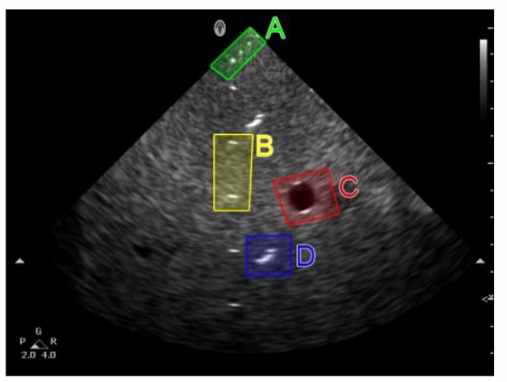
In the given image of a tissue-mimicking phantom, Option B (yellow box) is used to evaluate axial resolution. Axial resolution refers to the ability of the ultrasound system to distinguish between two structures that are close to each other along the path of the ultrasound beam (i.e., parallel to the beam). The targets in Option B are typically aligned in such a way to test the system's capacity to differentiate between structures that are situated closely together along the beam's axis. Reference:
ARDMS Sonography Principles and Instrumentation guidelines
'Sonography: Principles and Instruments' by Joan P. Baker and Marveen Craig
Exam domains verified against: Official ARDMS SPI exam guide, last checked October 2026.
Covers patient care, sonographic ergonomic techniques, interactions of sound and matter, and reflectors to modify scanning technique. Includes identifying potential bioeffects, applying beam steering and extended field of view concepts, and applying 3D/4D concepts including contrast imaging, initial patient encounter, and clinical history review.
Addresses selection of appropriate transducers, adjusting transducer frequency, and applying 2D array and 3D/4D transducer concepts. Includes understanding nonimaging transducer concepts and their clinical applications.
Encompasses optimization concepts for lateral, elevational, and temporal resolution, magnification techniques, and image brightness control. Includes applying harmonic imaging, PRF, output power, duty factor, dynamic range, spatial compounding, gray scale, edge enhancement, image depth, and M-mode concepts.
Covers wall filter and sample gate concepts, prioritizing color over gray scale, and applying principles to eliminate aliasing and identify artifacts. Includes spectral, power, and tissue Doppler concepts, evaluating hemodynamics, and performing Doppler measurements.
Sample question from this domain above: Q4
Includes documenting QA checks on ultrasound machines and assessing transducer integrity. Covers verifying ultrasound machine integrity, performing grayscale QA testing with tissue-mimicking phantoms, and applying statistical parameters for quality management.
Common questions about the exam itself

