Appian ACD200 Practice Exam Questions & Answers
7 Free Questions
· Last reviewed: October 11, 2026
· Prepared & Reviewed by the ValidExamDumps Editorial Team
Exam Facts
Appian ACD200 Exam Details
Key details for this exam, checked against the published exam outline
77
Practice Questions (Our Bank)
60 minutes
Exam Duration
70%
Passing Score
- Exam Code
- ACD200
- Full Name
- Appian Certified Senior Developer Exam
- Issuing Body
- Appian Certification Program
- Question Format (Our Bank)
- Multiple Choice, Hotspot
- Delivery
- Online proctored exam
- Eligibility
- No prerequisites required
- Validity
- 3 years
Practice Questions
Free ACD200 Practice Questions
Each question shows the correct answer and an explanation of why it is right
VA
ValidExamDumps Editorial Team
Every question and its answer is checked by our ACD200 exam
preparation team, who also write the explanation shown with each one.
How we research and review these pages
Your table contains several indexes.
Which two statements regarding indexes are correct? (Choose two.)
Correct Answer:
A, C
Explanation
Indexes speed up read operations by allowing the database to find data more quickly without scanning entire tables. However, indexes slow down write operations because the database must update the index whenever data is inserted, updated, or deleted. This overhead makes writes more expensive. The other options are incorrect because indexes do not improve write performance and do not reduce storage requirements.
What are three things you can do to improve the memory usage of a process model? (Choose three.)
Correct Answer:
B, C, E
Explanation
Process variables consume memory, so reducing their number directly decreases memory usage. Storing large text blocks in variables wastes memory unnecessarily. Passing data directly to activity nodes and smart services avoids storing that data in process variables, which frees up memory. The incorrect options typically involve keeping more data in variables or not considering memory constraints during process design.
You create an Integration that modifies the data.
In which three locations can it be called? (Choose three.)
Correct Answer:
C, D, E
Explanation
Data-modifying integrations can only be called from specific locations to maintain data integrity and security controls. Web APIs support POST, PUT, and DELETE methods for modifications. Process models can call integrations directly. SAIL interfaces can call integrations through the saveinto parameter. Other locations like read-only queries or scheduled tasks are not appropriate for integrations that change data.
You want to approve or reject an incoming deployment.
Which three roles allow you to do so? (Choose three.)
Correct Answer:
A, B, D
Explanation
Deployment approvals are controlled by role-based access in the administration console. The Specified Reviewer Group is explicitly configured to review deployments. System Administrators and Application Administrators Group have permissions to approve or reject incoming deployments as part of their administrative duties. Other roles lack the necessary permissions to make deployment decisions.
Which of the following is a sign that an application's performance is degrading and should be addressed with changes to the application design?
Correct Answer:
B
Explanation
When three of the top five most executed process models show low completion rates, it indicates a systemic performance problem affecting critical processes. Low completion percentages suggest users are abandoning processes or they are timing out due to performance issues. This pattern shows the application design needs improvement to handle the workload. Isolated instances or minor delays do not warrant redesign.
You are analyzing a poorly-performing process model.
You find that the process model in question has a lot of nodes and is mainly used to do background updates.
Which two things can be done to increase its performance? (Choose two.)
Correct Answer:
B, D
Explanation
Background update processes benefit from removing activity chaining because chaining forces sequential execution and adds overhead. Refactoring nodes into subprocesses improves organization and can enable parallel execution when appropriate. These changes reduce processing time and memory usage. Adding more logging or increasing timeouts would not improve performance and might worsen it.
Users are reporting that their application is slow to load customer records with many transactions.
Using performance monitoring tools, you find that the following interface definition is responsible for the vast majority of page load time:
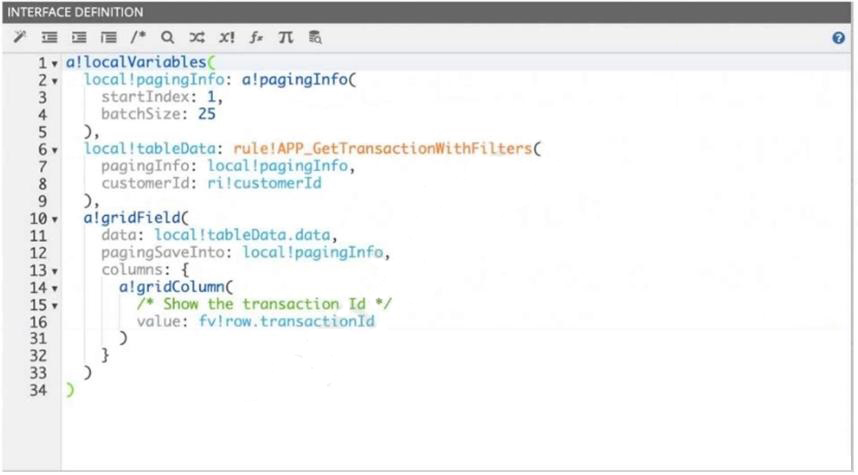
You also notice that both queries (rule!APP_GetTransactionsWithFilters and rule!APP_GetTransactionTypeWithFilters) take about 25 milliseconds each to execute when you test them using expression editor.
Which change would decrease the load time of this interface component the most? (Choose the best answer.)
Correct Answer:
D
Explanation
The interface is slow because it queries transaction types for every transaction row, even though the test queries are fast. The slowness comes from making the same query repeatedly across many rows. Prefetching the transaction types once and using displayvalue() to show them eliminates redundant queries. This reduces total page load time far more than optimizing individual query speed, which is already acceptable.
Full Access
Get the complete ACD200 question set
- 77 questions covering all exam domains
- Correct answers with explanations, like the free questions above
- PDF and online practice test
- 90 days of free updates
Domain 1: Platform Maintenance
15%
Troubleshoot applications using logs, performance dashboards, and the administration console. Perform technical review of application work and configure the administration console settings.
Sample question from this domain above:
Q4
Domain 2: Relational Databases
15%
Implement complex data models and maintain supporting database objects such as views, triggers, and stored procedures. Design data models that meet business requirements and document them properly.
Sample question from this domain above:
Q1
Domain 3: Application Design and Management
35%
Implement development best practices and deploy application artifacts across environments. Read, translate, and transform relational data within Appian, construct end-to-end applications, convert business requirements into user stories, and follow user experience best practices.
Sample question from this domain above:
Q3
Domain 4: Advanced Object Usage
10%
Create and configure simple connected system objects. Identify use cases and hazards associated with plug-in usage in Appian applications.
Domain 5: Performance & Scalability
25%
Design Appian components for performance and implement application data management strategies. Identify and communicate user-facing performance concerns, assess potential server memory risks using Process Monitoring, and conduct database load testing with recommendations.
Sample questions from this domain above:
Q2Q5Q6Q7
FAQ
ACD200 Exam FAQ
Common questions about the exam itself
Do I need to hold the Associate Developer certification before taking the Senior Developer exam?
Yes, the Appian Certified Associate Developer certification is required before you can sit for the Senior Developer exam. You should have passed the ACD100 exam and have at least 6 months of hands-on Appian project experience.
What is the hardest part of the ACD200 exam and how should I study it?
Performance and Scalability is the most heavily weighted domain at 25 percent, covering database load testing, performance optimization, and identifying bottlenecks. Focus on understanding how to design components that scale, implement data management strategies, and use the Process Monitoring tab to identify memory risks.
How long should I prepare for the ACD200 Senior Developer exam?
Most candidates with the required 6 to 12 months of project experience spend 4 to 8 weeks in focused preparation. The exact timeline depends on your hands-on experience with Application Design, Relational Databases, and Performance tuning on the Appian platform.
What happens on exam day for ACD200?
You take a 60-minute proctored exam delivered online with 40 questions in multiple-choice and multiple-response formats. You will have a live remote proctor monitoring your session, so ensure you have a quiet space, a stable internet connection, and valid photo identification.
Can I retake the ACD200 exam if I fail, and how soon?
Yes, you can retake the exam, but specific retake policies depend on the exam delivery vendor. Contact the vendor or check your exam confirmation for details on waiting periods between attempts and any associated fees.
How long is the Senior Developer certification valid, and what do I need to do to keep it current?
The Senior Developer certification is valid for 18 months from the date you pass the exam. You can renew it by attending the quarterly Release Showcase training before your certification expires.
What role does the ACD200 certification map to within Appian projects?
Senior Developers configure and administer the Appian platform, guide project teams through code reviews and technical escalation, and work with database administrators and DevOps teams. They handle enterprise-level challenges in system architecture, database design, and performance tuning.
How does the Senior Developer exam (ACD200) differ from the Lead Developer exam (ACD300)?
The Senior Developer exam tests your ability to design, build, deploy, and maintain scalable Appian applications with strong performance optimization and data management skills. The Lead Developer exam builds on this with more strategic enterprise architecture and organizational leadership content.
Which study resources does Appian provide for preparing for ACD200?
Appian offers the Accelerated Senior Developer course through Appian Academy, which covers the exam objectives in an eight-week program. You should also study the Appian documentation and learning paths aligned with each exam domain.

