At ValidExamDumps, we consistently monitor updates to the AICPA CPA-Business exam questions by AICPA. Whenever our team identifies changes in the exam questions, objectives, focus areas or requirements, We immediately update our exam questions for both PDF and online practice exams. This commitment ensures our customers always have access to the most current and accurate questions. By preparing with these up to date and 100% exam domain coverage questions, our customers can successfully pass the AICPA CPA Business Environment and Concepts exam on their first attempt without needing additional materials or study guides.
Other certification materials providers often include outdated or removed questions by AICPA in their CPA-Business exam. These outdated questions lead to customers failing their AICPA CPA Business Environment and Concepts exam. In contrast, we ensure our questions bank includes only precise and up-to-date questions. Our main priority is your success in the AICPA CPA-Business exam, not profiting from selling obsolete exam questions in PDF or Online Practice Test.
Which one of the following most accurately describes the normal sequence of a business cycle?
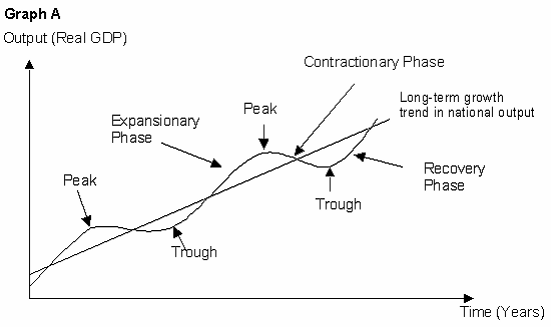
Choice 'b' is correct. The sequence of a typical business cycle includes an expansionary phase, a peak of economic activity, a contractionary phase, and a trough of economic activity.
Choice 'a' is incorrect. A peak does not follow a trough.
Choice 'c' is incorrect. A trough does not follow an expansion.
Choice 'd' is incorrect. A contraction does not follow a trough.
The net present value (NPV) of a project has been calculated to be $215,000. Which one of the following changes in assumptions would decrease the NPV?
Choice 'd' is correct. An increase in the discount rate will decrease the present value of future cash inflows and, therefore, decrease the net present value of the project.
Each of the other options would increase the NPV:
Choice 'a' is incorrect. A decrease in the estimated effective income tax rate will reduce the depreciation tax shield and therefore increase the cash inflow. A larger cash inflow in the future will increase the present value of the cash inflows and therefore increase the net present value of the project.
Choice 'b' is incorrect. Increasing the project life and associated cash inflows will increase the present value of the cash inflows and therefore increase the net present value.
Choice 'c' is incorrect. An increase in the estimated salvage value will decrease the present value of the cash outflow and therefore increase the net present value.
A working capital technique that increases the payable float and, therefore, delays the outflow of cash is:
Choice 'b' is correct. A draft is a working capital technique that increases the payable float and, therefore, delays the outflow of cash.
Each of the three following choices accelerate the flow of cash and/or data:
Choice 'a' is incorrect. Concentration banking automatically channels funds from every source of the business into a single usable account, thus quickly identifying available funds each day, and moving them to accounts that have funding requirements that day, and investing the remainder in short-term, interestbearing instruments until needed.
Choice 'c' is incorrect. A lock-box system is simply a central collection location that receives payment checks (generally, the bank where a central checking account is maintained by the firm).
Choice 'd' is incorrect. The use of a local post office box allows more rapid access to mail than actual delivery to a street address.
Which of the following transactions does not change the current ratio and does not change the total current assets?
Choice 'a' is correct. This does not change the current ratio because the reduction of cash is offset by an increase in accounts receivable.
Choice 'b' is incorrect. A cash dividend increases current liabilities without increasing current assets. Although current assets remain unchanged (until the payment happens), the current ratio will change.
Choice 'c' is incorrect. Cash is reduced and current liabilities are reduceD. Total current assets will change (they will be reduced).
Choice 'd' is incorrect. The payment of cash reduces current assets. Long-term assets are increased, as well as long-term and short-term liabilities. The current ratio is reduced.
A partner's interest in specific partnership property is:
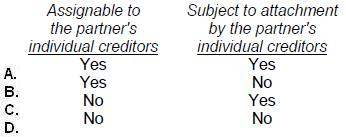
Choice 'd' is correct. No - No.
Rule: A partner's interest in specific partnership property is neither assignable to the partner's individual creditors nor is it subject to attachment by the partner's individual creditors.
Choices 'a', 'b', and 'c' are incorrect, per the above rule.

