Key details for this exam, checked against the published exam outline
Each question shows the correct answer and an explanation of why it is right
An Adobe Real-Time CDP (RTCDP) consultant is working on a next-page personalization use case for an e-commerce client's website. The client wanted to use Adobe Target for delivering personalized experiences using Adobe Experience Platform (AEP) Edge segments. The client has already implemented Web SDK and configured Datastream to share website event data with AEP and Adobe Target. While implementing the delivery of personalized experiences, the RTCDP consultant was not able to get the right experience rendered successfully. Which two debugging steps can the RTCDP consultant take to identify the issue? (Choose two.)
To deliver next-page personalization using Adobe Target and AEP segments, several technical 'handshakes' must be correctly configured within the Edge Network architecture.
Step B is foundational. For Adobe Target to receive segment membership information from AEP via the Web SDK, the Datastream must be explicitly configured to support this. Under the Adobe Experience Platform service within the Datastream UI, the consultant must ensure that the Edge Segmentation toggle is enabled. This setting allows the Edge Network to evaluate segments in real-time during the request. Additionally, the Personalization Destinations must be active to allow Target to 'see' these segment IDs in the edge response.
Step C addresses the data assembly layer. Not all segments are automatically projected to the Edge Network. A segment must be evaluated using a Merge Policy that is marked as Active-on-edge. This flag tells the Profile Service to synchronize the necessary profile fragments and segment statuses to the Edge Network's distributed data centers. If the merge policy is not edge-enabled, the segment will only be evaluated in the Hub, causing a delay that prevents 'next-page' personalization.
Option A is a legacy concern, as the Web SDK handles the delivery regardless of the specific Target extension version. Option D is incorrect because Target destinations are managed through Datastream configurations and segment activation, not a single-destination restriction. Debugging these two points (B and C) ensures the infrastructure is ready to process and deliver segment data at the speed required for real-time web experiences.
An organization is tracking three types of identifiers for their customers: email, mobile number, and customer relationship management (CRM) ID and wants to merge identities in the Real-Time Customer Profile and segment audiences in Adobe Experience Platform. Which strategy would be used?
The most effective strategy for merging identities in Adobe Experience Platform is to leverage the Identity Map to include all available identifiers. In XDM schemas, you can designate multiple fields as identities. By including Email, Mobile Number, and CRM ID as identities, the Identity Service can use any of these values to find and link fragments of a customer's profile.
Selecting only one primary identifier (as suggested in Options A and C) is a restrictive legacy approach. In a modern CDP architecture, 'Identity Stitching' is dynamic. If a customer provides their Email in one session and their Mobile Number in another, and a third record (the CRM) contains both, the Identity Graph links all three. This creates a multi-dimensional identity that allows for segmentation regardless of which ID is present in the incoming data stream.
Using all identifiers within an Identity Map ensures the highest possible 'match rate' for audience segmentation. For instance, if you are activating an audience to a social media destination that requires an Email, but your latest interaction only captured a Mobile Number, the platform uses the Identity Graph to retrieve the associated Email from the unified profile. This cross-channel recognition is only possible when all identifiers are treated as part of the stitched identity web rather than prioritizing one at the expense of others.
A healthcare client plans to send data from a wearable device using the Edge data ingestion capability of Adobe Experience Platform. The data architect of the client has created a schema that includes fields labeled as sensitive. If a Datastream is created that is associated with the mentioned schema above, what are the services that can be added to the Datastream?
In Adobe Experience Platform, data governance and compliance are enforced through the use of Data Usage Labeling and Enforcement (DULE). For healthcare organizations handling Protected Health Information (PHI), the platform requires strict adherence to HIPAA compliance standards. When a schema contains fields labeled as sensitive (such as those associated with HIPAA-regulated data), the Datastream configuration is restricted by the system's governance guardrails.
Specifically, if a schema is part of a healthcare-related implementation where PHI is present, you can only enable HIPAA-ready services within the Datastream. As of the latest Adobe documentation, Adobe Experience Platform (which includes Real-Time CDP) is a HIPAA-ready service when configured within a compliant organization. Other services like Adobe Analytics or standard Adobe Target are not inherently HIPAA-ready in all configurations and may be blocked from receiving data from a sensitive-labeled schema to prevent data leakage into non-compliant environments.
Options A and D are incorrect because they suggest that non-HIPAA-ready services (like standard Event Forwarding) could coexist with sensitive data, which would violate the compliance boundary. Option B is incorrect as it includes legacy services that do not meet the stringent encryption and access control requirements for PHI. By restricting the Datastream to HIPAA-ready services, Adobe ensures that sensitive health data is only processed within environments that have the necessary technical and administrative safeguards in place.
How does the Adobe Real-Time CDP manage data when multiple records, coming from different sources but belonging to the same customer, are processed?
The fundamental value proposition of Adobe Real-Time CDP is its ability to break down data silos by creating a 360-degree view of the customer. When the system ingests multiple records from different sources (such as a CRM system, an e-commerce platform, and web clickstream data) that share common identifiers, it uses the Identity Service to recognize they belong to the same person.
The platform then dynamically merges these 'profile fragments' into a single, unified Real-Time Customer Profile. This merging happens in real-time, ensuring that as soon as new data arrives, it is reflected in the unified view. This process allows for consistent personalization across channels; for example, a purchase made offline in a retail store can immediately suppress 'buy now' ads for that same product on the website.
Option B is incorrect as it describes the very siloed state the CDP is designed to solve. Option C is incorrect because the platform preserves all relevant behavioral and attribute data rather than discarding records based on frequency. Option D is a slight misinterpretation of Merge Policies; while Merge Policies can prioritize one source over another for a specific attribute (Timestamp-ordered or Dataset-precedence), the platform still merges the records into a single profile rather than just weighing them.
A data engineer has loaded several profile fragments onto a Real-Time Customer Profile The profile fragments use an Individual Profile class-based schema, where user-id is the primary identity. The engineer checks each fragment, as follows:
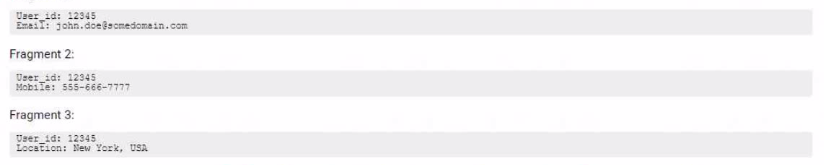
However, upon Inspection of the profile, they realize that only the email from Fragment 1 appears, while mobile and location from Fragments 2 and 3 do not.
What is the most likely reason for the missing data in Real-Time Customer Profile'
In Adobe Real-Time CDP, the Real-Time Customer Profile does not simply aggregate every piece of data ingested into the system by default. Instead, it utilizes Merge Policies to determine which datasets are 'trusted' and should contribute to the final, unified view of a customer. Even if data is successfully ingested into a dataset and correctly linked via a primary identity like user_id, it will not appear in the unified profile if the source dataset is not included in the active Merge Policy.
When the data engineer observes that attributes from Fragment 2 (Mobile) and Fragment 3 (Location) are missing while Fragment 1 (Email) is present, the most probable cause is that the datasets containing Fragments 2 and 3 have not been added to the Dataset Precedence or are not part of the union governed by the specific Merge Policy being viewed. In AEP, you can create multiple Merge Policies for different use cases; if the UI is set to a policy that only includes the 'Email System' dataset, other attributes will remain hidden from that specific profile view.
Options B and C are incorrect because the Real-Time Customer Profile is designed to be eventually consistent and non-linear; the system handles fragments loaded at different times or in different orders by constantly re-evaluating the profile as new data arrives. Option D is factually incorrect, as Mobile and Location are standard attributes within XDM. Therefore, ensuring the datasets are correctly enabled for Profile and included in the relevant Merge Policy is the critical step for data visibility.
A multinational company is transitioning its on-premises data warehouse to the Adobe Experience Platform in an attempt to reap the benefits of real-time data and cloud scalability. The current data warehouse includes a complex set of relational databases with numerous tables including Orders, OrderDetails, Customers, Products, and Suppliers. The Orders and OrderDetails are interconnected with a one-to-many relationship, while the rest of the tables have many-to-many relationships.
Which two approaches should be followed while translating this release database management system (RDBMS) schema to Adobe Real-Time Customer Data Platform's (Adobe Real-Time CDP) NoSQL data model, considering the maintenance of data relationships? (Choose two.)
Translating a relational (RDBMS) model to the Adobe Experience Platform's NoSQL-based XDM requires a shift from 'joined tables' to 'hierarchical and linked objects.'
Approach C is essential for handling 1:N relationships where the data is highly coupled, such as Orders and OrderDetails. In XDM, rather than having a separate table for line items, you should use nested fields (or an array of objects) within the Order schema. This ensures that when an 'Order' event is retrieved, all its details are available in a single document, maximizing performance for real-time segmentation and activation without needing complex joins.
Approach E addresses the broader relational structure. For entities like Products or Suppliers, Adobe utilizes Lookup Schemas. By defining a relationship between an ExperienceEvent (the Order) and a Lookup Schema (the Product), the Real-Time Customer Profile can 'hydrate' event data with descriptive attributes from the lookup table at the time of processing. Furthermore, for many-to-many (N:N) relationships, XDM utilizes arrays of strings or objects to store multiple identifiers within a single profile or event record. This denormalized approach is fundamental to NoSQL scalability, as it allows the platform to maintain data integrity and relationship context while providing the sub-second query speeds required for real-time use cases.
Exam domains verified against: Official Adobe AD0-E605 exam guide, last checked October 2026.
Transform relational database designs into Adobe Real-Time CDP's NoSQL data model through practical schema mapping. Build identity strategies that establish correct relationships between data entities and enforce best practices for Real-Time Customer Profile modeling.
Learn how profile assembly combines data from multiple sources into a single unified view. Understand how the Identity Graph resolves customer identities and discover the differences between edge profiles deployed at regional nodes and hub profiles stored centrally.
Work with CDP ingestion methods including batch processing and streaming. Apply edge ingestion techniques to optimize data flow and implement advanced architectural patterns for reliable, scalable data collection across systems.
Sample question from this domain above: Q5
Build audiences and segments using CDP tools and understand how different segmentation types such as batch, streaming, and edge operate. Apply real use cases to segment customers and activate audiences across channels.
Implement activation patterns that deliver customer data to destinations and channels. Stay within platform guardrails and configure on-site personalization to deliver real-time experiences based on segment membership.
Apply governance best practices across CDP implementation to manage data quality, privacy, and compliance. Understand how to control data flow across services and enforce organizational policies.
Monitor CDP operations using built-in dashboards and alerts. Track license usage and identify quota constraints. Configure attribute-based access control to manage permissions and define use cases for ABAC within Real-Time CDP.
Common questions about the exam itself

