Adobe AD0-E137 Practice Exam Questions & Answers
7 Free Questions
· Last reviewed: October 12, 2026
· Prepared & Reviewed by the ValidExamDumps Editorial Team
Exam Facts
Adobe AD0-E137 Exam Details
Key details for this exam, checked against the published exam outline
50
Practice Questions (Our Bank)
100 minutes
Exam Duration
32 out of 50
Passing Score
USD 225
Official Exam Fee
- Exam Code
- AD0-E137
- Full Name
- Adobe Experience Manager Sites Developer Expert
- Issuing Body
- Adobe
- Question Format (Our Bank)
- Multiple Choice
- Delivery
- Online proctored
- Validity
- 2 years
Practice Questions
Free AD0-E137 Practice Questions
Each question shows the correct answer and an explanation of why it is right
VA
ValidExamDumps Editorial Team
Every question and its answer is checked by our AD0-E137 exam
preparation team, who also write the explanation shown with each one.
How we research and review these pages
A developer is tasked with designing a solution to accommodate multiple client projects within a single Adobe Experience Manager (AEM) instance, each requiring its own set of unique resources, code, and content.
Given the need for true multi-tenancy, where each tenant operates independently with zero knowledge of other tenants and no shared code, content, or common authors, which approach should the developer recommend?
Correct Answer:
A
Explanation
True multi-tenancy in AEM requires complete isolation where each tenant has its own author and publish instances with no shared resources, code, or content. This ensures zero cross-tenant knowledge and prevents data bleeding. Other approaches like using different workspaces or content paths still share the same underlying instance, code base, and infrastructure, which violates true multi-tenancy requirements where tenants must be completely independent.
A developer needs to use the mode in Template Editor which allows template authors to define grid settings for different devices.
Which mode should the developer use?
Correct Answer:
A
Explanation
The Layout mode in Template Editor is specifically designed for template authors to define responsive grid settings for different devices. This allows authors to configure how component containers behave across mobile, tablet, and desktop breakpoints. Design mode handles component policies, while other modes manage different aspects of template configuration but not device-specific grid layouts.
What is the default file to store the dispatcher cache configuration?
Correct Answer:
B
Explanation
This question tests HTL syntax and URL path generation in component development. Option B is correct because it uses the proper HTL expression syntax and generates a valid path structure. Options A and C have incorrect path ordering - they either place the HTML extension before the path segment or put the full content path after the file extension. Understanding HTL expression language and proper URL construction is core to component development.
From which source environment can content be copied to Stage using Content sets in Cloud Manager?
Correct Answer:
C
Explanation
Configuring AEM as a Cloud Service environments requires setting up OSGi configurations for specific run modes. The path structure apps/Project Name/osgiconfig/config.publish.uat/ targets the publish tier in the UAT environment. The .cfg.json file format is standard for AEM Cloud Service. This configuration approach is fundamental to environment setup and multi-tenancy management.
A developer has created a new Sling Model called Flarp. The developer wants to create a unit test for this Sling Model.
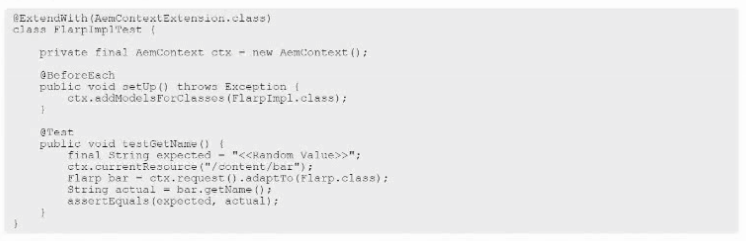
What needs to be changed for the unit test to successfully test the getName method of the Flarp Sling Model?
Correct Answer:
A
Explanation
Sling Models require SlingContext instead of AemContext for proper unit testing because SlingContext provides the Sling environment that Sling Models depend on. Using ResourceResolverType.JCR_OAK ensures you have a real JCR repository available during testing. AemContext is broader and less specific to Sling Model testing needs. The SlingContext with JCR_OAK provides the exact test environment Sling Models expect when resolving dependencies and accessing resources.
Which tool is commonly used to manage front-end dependencies and automate tasks like bundling, minification, and transpilation in an AEM project?
Correct Answer:
A
Explanation
Dispatcher caching must balance performance with personalization needs. Caching HTML files improves speed, but when URL parameters are present, they typically indicate personalized or dynamic content. Configuring the dispatcher to invalidate cache for URLs with query strings ensures personalized content isn't served from stale cache. This prevents delivering one user's personalized content to another user while maintaining efficiency for static content.
A developer is writing a unit test for a service that depends on a query of nodes inside the JCR.
What is the correct approach to unit testing the service?
Correct Answer:
A
Explanation
Using @Mock on the Query object with when and then methods allows you to mock JCR queries without needing a real repository during unit tests. This keeps tests fast and isolated from external dependencies. Other approaches like using real JCR instances make tests slower and harder to control. Mocking gives you predictable query results for testing business logic without repository overhead. The when-then pattern lets you specify exactly what the query should return for different test scenarios.
Full Access
Get the complete AD0-E137 question set
- 50 questions covering all exam domains
- Correct answers with explanations, like the free questions above
- PDF and online practice test
- 90 days of free updates
Domain 1: Configurations
24%
Configure dispatcher rules, multi-tenancy, SAML and LDAP authentication, replication agents, editable templates and content fragment models. Hands-on setup of these foundational AEM components ensures your deployment can handle enterprise requirements and secure user access.
Sample questions from this domain above:
Q1Q2Q3
Domain 2: AEM Development
33%
Build SPAs, Sling Models, HTL components, unit tests, third-party integrations, OSGi services and servlets. Master JCR query selection for performance. This is the largest domain because component development and API integration are daily work for AEM developers.
Sample questions from this domain above:
Q5Q7
Domain 3: Build and Deployment
25%
Manage Maven dependencies, create projects with archetypes, configure custom run modes, implement workflows and Oak indexes. These skills let you automate builds, organize code for teams and optimize repository performance across environments.
Sample question from this domain above:
Q6
Domain 4: Environment Maintenance
18%
Manage AEM configurations, handle release upgrades, sync content across instances with package manager and use maintenance tools. Keeping environments stable and in sync prevents data loss and downtime in production systems.
Sample question from this domain above:
Q4
FAQ
AD0-E137 Exam FAQ
Common questions about the exam itself
What experience level does AD0-E137 expect?
Adobe targets 1 to 3 years of hands-on AEM development experience for this expert-level exam. You need real-world exposure to building components, configuring instances and deploying to multiple environments, not just course work.
How long should I study for AD0-E137?
Most candidates prepare for 4 to 8 weeks with focused study on the four domains and hands-on labs. The depth of AEM Development and Build and Deployment means these two areas need the most practice time and scenario work.
Which domain is hardest in AD0-E137?
AEM Development at 33 percent weighting is both the largest domain and the hardest because it covers HTL templating, Sling Models, OSGi services and third-party integrations all together. These require deep Java knowledge and practical coding experience.
What is the passing score for AD0-E137?
You must score at least 32 out of 50 questions correctly to pass, which is a 64 percent pass rate. This reflects the expert difficulty of the exam.
Can I retake AD0-E137 if I fail?
Yes, you can retake the exam. After your first failure you must wait 5 days before purchasing another attempt, then 10 days for a third attempt, 15 days for a fourth, and 30 days for a fifth.
How long does AD0-E137 certification stay valid?
Your Adobe Experience Manager Sites Developer Expert certification is valid for 2 years from the date you pass. You can renew it automatically by passing two short renewal modules at no cost within the 2-year window.
What is the exam format for AD0-E137?
The exam has 50 multiple choice questions and you have 100 minutes to complete it. Questions test both theory and practical problem-solving in real-world AEM scenarios, not just definitions.
Is AD0-E137 proctored and can I take it at home?
Yes, the exam is online proctored through easyProctor. You take it from home or any private space where you can run the Process Tracker software and allow camera and microphone access for the entire exam.
What job role does AD0-E137 map to?
This certification targets Senior AEM Developers and AEM Developers who own component building, site architecture and deployment. It validates you can lead technical decisions on AEM projects for enterprise customers.
How does AD0-E137 relate to other AEM exams?
AD0-E137 is the expert-level Sites developer exam. Candidates typically start with AD0-E126 Business Practitioner or AD0-E132 Technical Foundations before moving to this expert exam to build foundational knowledge first.

