AACN CCRN-Adult Practice Exam Questions & Answers
7 Free Questions
· Last reviewed: October 20, 2026
· Prepared & Reviewed by the ValidExamDumps Editorial Team
Exam Facts
AACN CCRN-Adult Exam Details
Key details for this exam, checked against the published exam outline
150
Practice Questions (Our Bank)
180 minutes
Exam Duration
83 out of 125 scored questions
Passing Score
- Exam Code
- CCRN-Adult
- Full Name
- CCRN (Adult) - Direct Care Eligibility Pathway
- Issuing Body
- AACN Certification Corporation
- Question Format (Our Bank)
- Multiple Choice
- Official Exam Fee
- USD 365 (non-members). USD 250 (AACN members)
- Delivery
- Computer-based at PSI testing centers or via Live Remote Proctoring from home
- Eligibility
- Current unencumbered U.S. RN or APRN license required. Must have completed a minimum of 2,000 hours in direct care of acutely/critically ill adult patients within the last five years. Majority of hours must focus on critically ill patients. Hours must be
- Validity
- 3 years
Practice Questions
Free CCRN-Adult Practice Questions
Each question shows the correct answer and an explanation of why it is right
VA
ValidExamDumps Editorial Team
Every question and its answer is checked by our CCRN-Adult exam
preparation team, who also write the explanation shown with each one.
How we research and review these pages
A patient is intubated and receiving assist control mechanical ventilation and is on a norepinephrine drip following a head injury. Patient data are:
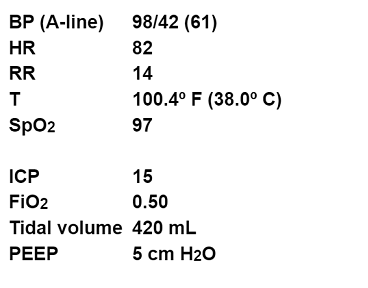
Which of the following interventions will improve cerebral perfusion?
Correct Answer:
B
A physician tries three times to insert a central line, then says, "I think I can get it this time." A nurse should
Correct Answer:
A
Explanation
When a physician has attempted to insert a central line multiple times without success, the nurse's responsibility includes ensuring patient safety and advocating for the patient. Continued attempts by the same physician may increase the risk of complications, such as infection or trauma. Therefore, the nurse should suggest that another physician, possibly one with more experience or skill in central line insertion, perform the procedure. Reference: AACN Adult CCRN Certification Review Course, AACN CCRN Exam Handbook.
Which of the following are most indicative of acute pancreatitis?
Correct Answer:
D
The family of a patient with trauma believes that the patient is in pain and requests that a neighbor, a therapeutic touch practitioner, be allowed to see the patient. Unit policy allows visits by immediate family only. Which of the following is the most important consideration in a nurse's decision about facilitating the visit?
Correct Answer:
D
Explanation
The primary consideration is to ensure that the family understands the unit's visitation policies. While alternative modalities like therapeutic touch can be beneficial, the nurse must adhere to established policies and explain the rationale to the family. This helps maintain the integrity of unit operations and ensures that all patients receive equitable care. Explaining the policies also provides an opportunity to discuss alternative ways to support the patient within the existing framework. Reference: = CCRN Exam Handbook, AACN Adult CCRN Certification Review Course
A patient with a history of six cardiac catheterizations relates that he has received differing instructions about the duration of required bedrest after the procedure. To further investigate this issue, which of the following is a nurse's most appropriate action?
Correct Answer:
C
Explanation
The nurse's most appropriate action is to review recent published research about bedrest protocols, as this would provide the nurse with the most current and reliable evidence to guide clinical practice and improve patient outcomes. Bedrest protocols after cardiac catheterization may vary depending on the type of access site, the use of closure devices, the patient's risk factors, and the clinician's preference. However, there is a growing body of research that supports early ambulation and shorter bedrest duration to reduce the risk of complications, such as bleeding, hematoma, back pain, and venous thromboembolism, and to enhance patient comfort and satisfaction123. Asking about obtaining an independent evaluation of unit outcomes, conducting an informal chart review and outcome evaluation of patients treated with different bedrest protocols, or asking the nursing supervisor to request standardized physician orders for patients who have undergone catheterization are not the most appropriate actions, as they may not reflect the best available evidence, may be biased or incomplete, or may not address the patient's concern.
1: Bedrest After Cardiac Catheterization: A Systematic Review and Meta-analysis4, p. 1-2.
2: Early Ambulation After Cardiac Catheterization: A Literature Review, p. 1-2.
3: Bed Rest After Cardiac Catheterization: A Review of the Evidence, p. 1-2.
A patient underwent a successful percutaneous coronary intervention to the left anterior descending coronary artery. The patient suddenly begins to complain of dyspnea, jaw pain, and chest tightness. The bedside monitor displays sinus tachycardia and ST segment elevation in lead V2. The patient's neck veins are flat and BP is 152/98. Which of the following is the most likely cause of the patient's symptoms?
Correct Answer:
B
Explanation
The patient presents with dyspnea, jaw pain, chest tightness, and sinus tachycardia with ST segment elevation in lead V2 after a percutaneous coronary intervention (PCI). These symptoms are indicative of myocardial ischemia or infarction, likely due to a re-occlusion of the treated coronary artery. Coronary artery occlusion is a common cause of these acute symptoms post-PCI. Other options like pulmonary hypertension, vasovagal reaction, and cardiac tamponade are less consistent with the clinical presentation. Reference: AACN Adult CCRN Certification Review Course, AACN CCRN Exam Handbook.
A nurse has responded to a rapid response call on a medical-surgical floor in the hospital. The nurse finds the patient with the following data:
BP 72/30
HR 132
RR 24
T 102.3 F (39.0 C)
SpO2 95%
Ph 7.13
PaCO2 34 mm Hg
PaO2 88 mm Hg
HCO3 14 mEq/L
Na+ 142 mEq/L
The nurse should anticipate an order to administer which of the following?
Correct Answer:
B
Explanation
The patient's data indicate that the patient is in shock, which is a life-threatening condition characterized by inadequate tissue perfusion and organ dysfunction. The patient has a low blood pressure, a high heart rate, a fever, and a metabolic acidosis, which suggest that the patient may have septic shock, which is caused by a severe infection that triggers a systemic inflammatory response. The nurse should anticipate an order to administer phenylephrine (Neo-Synephrine), which is a vasopressor agent that constricts the blood vessels and increases the blood pressure and tissue perfusion. Phenylephrine is recommended as a first-line agent for septic shock by the Surviving Sepsis Campaign guidelines1. 8.4% sodium bicarbonate is not indicated for the treatment of septic shock, as it may worsen the acid-base balance and increase the risk of complications2. 0.9% sodium chloride is a normal saline solution that may be used for fluid resuscitation, but it may not be sufficient to restore the blood pressure and may cause fluid overload, hyperchloremia, and kidney injury3. Amiodarone (Cordarone) is an antiarrhythmic drug that is used to treat ventricular tachycardia or fibrillation, but it is not effective for septic shock and may cause hypotension, bradycardia, and other adverse effects4.
Surviving Sepsis Campaign. (2020). Surviving Sepsis Campaign: Guidelines on the Management of Critically Ill Adults with Coronavirus Disease 2019 (COVID-19). Retrieved from 1, p. 16.
Marik, P. E., & Bellomo, R. (2013). A rational approach to fluid therapy in sepsis. British Journal of Anaesthesia, 110(3), 323-329. Retrieved from 2, p. 327.
Semler, M. W., & Rice, T. W. (2019). Saline versus balanced crystalloids for intravenous fluid therapy in the emergency department: study protocol for a cluster-randomized, multiple-crossover trial. Trials, 20(1), 1-10. Retrieved from 3, p. 2-3.
Lexicomp Online. (2021). Amiodarone. Retrieved from 4, p. 1-2.
Full Access
Get the complete CCRN-Adult question set
- 150 questions covering all exam domains
- Correct answers with explanations, like the free questions above
- PDF and online practice test
- 90 days of free updates
Domain 1: I. CLINICAL JUDGMENT
80%
Encompasses five subcategories covering acute cardiovascular conditions (17% of total), respiratory emergencies (15%), endocrine, hematologic, gastrointestinal, renal and skin conditions (20%), musculoskeletal, neurological and behavioral disorders (14%), and multisystem conditions like sepsis, shock states and trauma (14%). Requires integration of pathophysiology knowledge with critical assessment and rapid decision-making across organ systems.
Sample questions from this domain above:
Q1Q2Q3Q4Q5Q7
Domain 2: II. PROFESSIONAL CARING & ETHICAL PRACTICE (20%)
20%
Tests advocacy, moral agency, caring practices, response to diversity, facilitation of learning, collaboration and clinical inquiry. Focuses on the AACN Synergy Model for Patient Care and how critical care nurses integrate evidence-based practice with compassionate patient-centered care, support interdisciplinary teams, and advance the profession through ongoing inquiry.
Sample question from this domain above:
Q6
FAQ
CCRN-Adult Exam FAQ
Common questions about the exam itself
What clinical experience do I need to sit the CCRN-Adult exam?
You must have completed at least 2,000 hours providing direct care to acutely and critically ill adult patients within the last five years. The majority of those hours must focus on critically ill patients. Hours must be verifiable by your clinical supervisor or a professional colleague (RN or physician) and contact information is required in case AACN audits your application.
How is the CCRN-Adult exam scored and what score do I need to pass?
The exam contains 150 total questions: 125 are scored and 25 are unscored items used for statistical data. You must answer a minimum of 83 scored questions correctly to pass. AACN uses a modified Angoff method where panelists set the cut score based on difficulty ratings of each question.
How many times can I retake the CCRN-Adult exam in 12 months?
You may take the CCRN-Adult exam up to four times within a 12-month period. If you do not pass, you are eligible for a discounted retest fee of USD 175 for members or USD 280 for non-members, available until you pass the exam.
Where and how can I take the CCRN-Adult exam?
The exam is computer-based and can be taken at PSI testing centers or through Live Remote Proctoring from your home. PSI administers the exam and locations, dates and scheduling are available on the PSI website. For remote proctoring, you need a quiet space free from distractions and a government-issued ID with photo and signature.
How long is the CCRN-Adult certification valid and what does renewal involve?
Your CCRN-Adult certification is valid for three years. To renew, you must maintain an active RN or APRN license and either pass the exam again or complete 100 Continuing Education Recognition Points (CERPs) through the Synergy CERP program. You also must meet practice hour requirements: 432 hours in direct patient care over three years, with at least 144 hours in the 12 months before your renewal date.
What exam fee do I pay for CCRN-Adult and when is it due?
The exam fee is USD 250 for AACN members or USD 365 for non-members. You pay this fee when you apply online through your AACN account using a credit card, or you can mail a paper application and pay by check. After payment, you receive a confirmation email and can schedule your exam.
What is the difference between CCRN-Adult Direct Care, Tele-critical Care and Knowledge Professional pathways?
All three pathways sit the same exam with the same content and passing score of 83. The Direct Care pathway is for nurses actively providing bedside care to critically ill patients. Tele-critical Care is for nurses providing teleICU care. Knowledge Professional is for nurses in roles such as educator, manager, director or faculty who influence critical care but do not provide direct care. Each has different practice hour requirements for initial certification and renewal.
Is there a time limit to schedule and take the CCRN-Adult exam after I apply?
Yes. After you receive your confirmation email from AACN, you must schedule and sit the exam within 180 days. If you do not test within this window, your application expires and you must reapply and pay the fee again.
How does CCRN-Adult differ from CCRN-K (Adult) and which should I take?
Both exams are identical in content, format and passing score. CCRN-Adult is for nurses with 2,000 hours of direct care in the past five years. CCRN-K (Adult) is for nurses with broader knowledge-focused experience but fewer direct care hours. Choose the pathway that matches your role: if you provide hands-on critical care, take CCRN-Adult. if you influence critical care through teaching, management or research, CCRN-K may be a better fit.
What topics are hardest on the CCRN-Adult exam and how should I prepare?
Candidates often find the Cardiovascular (17% of Clinical Judgment), Respiratory (15%) and Endocrine/Hematologic/GI/Renal sections (20%) most challenging because they require rapid synthesis of complex pathophysiology and clinical decisions. Use your CCRN Exam Handbook test plan to identify weak areas, review AACN's official exam bibliography, and work through practice questions with detailed answer rationales. Expect to spend 3-6 months in focused preparation if you work full-time.

