Key details for this exam, checked against the published exam outline
Each question shows the correct answer and an explanation of why it is right
A retail organization is Introducing an e-commerce channel and would like to integrate the customer's browsing and online purchase data into the Real-Time Customer Profile The data structure of the clickstream event being captured is as follows:
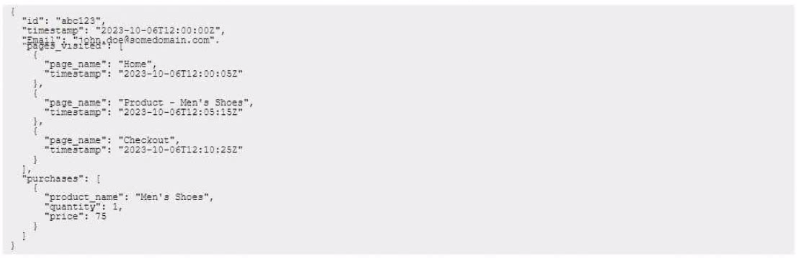
The architect decides to separate 'pages.vislted" and 'purchases' Into different schemas.
Which Experience Data Model XDM schema classes would be used to model the browsing activity and the purchase activity?
In Adobe Real-Time Customer Data Platform, the classification of data into Experience Data Model (XDM) classes depends on the nature of the information---specifically whether it describes a state or an event. Both 'browsing activity' (page visits) and 'purchase activity' are fundamentally behavioral, time-series events that occur at a specific point in time.
The XDM ExperienceEvent class is purpose-built to capture these 'point-in-time' occurrences. For browsing data, each page view is an event with a timestamp and specific attributes (like page name). Similarly, a purchase is a discrete transaction that happens at a particular moment. Modeling both as ExperienceEvents allows the Real-Time Customer Profile to maintain a chronological timeline of a customer's journey, which is essential for calculating journey-based metrics and triggering real-time orchestration.
Option A and B are incorrect because the XDM Individual Profile class is intended for persistent, slow-changing attributes (such as name, email, or loyalty tier) rather than transactional or behavioral data. Storing purchase data in a profile schema would fail to capture the historical context of multiple transactions. Option D is incorrect because 'XDM Product' is typically a lookup schema used to provide descriptive details about a SKU, not to record the act of purchasing itself. By utilizing the ExperienceEvent class for both activities, the architect ensures that the data is optimized for the Segmentation Service, allowing for complex queries like 'customers who viewed a product but did not purchase it within the last 24 hours.'
In the context of Adobe's Real-Time CDP, what defines an Identity Graph?
In Adobe Real-Time CDP, an Identity Graph is a structural representation of the relationships between different identity namespaces that belong to an individual. It is the engine that enables Identity Stitching. When multiple datasets are ingested into the platform, they often contain different 'fragments' of a customer's identity---for instance, one dataset might identify a user by their Email, while another uses a loyalty_id. The Identity Graph manages these connections, ensuring that all data associated with these various IDs is aggregated into a single, unified profile.
Option B describes a transaction log, not an identity structure. Option C is incorrect because the graph links identities (people), not the datasets themselves. Option D describes a 'Customer Journey,' which is a visualization of interactions over time; while the Identity Graph enables the tracking of that journey by linking the sessions, the graph itself is strictly the map of identity overlaps. By maintaining this graph, Real-Time CDP can resolve identities in real-time, allowing for consistent messaging even as a customer moves between anonymous browsing and authenticated states across different devices and platforms.
A company is looking to model their data architecture in Adobe Real-Time CDP that includes customer transactions across multiple platforms. What is the approach to define identity graph for a customer in Adobe Real-Time CDP to track a customer's activities across multiple platforms?
To successfully track a customer across multiple platforms (e.g., Web, Mobile App, and POS), the Identity Service must be able to recognize that a value in one system refers to the same person as a value in another. This is achieved by defining common identity namespaces.
For example, if the Web platform uses an email address to identify a user and the Mobile App also uses an email address, both should map to the standard 'Email' namespace. If the platforms used different namespaces for the same data type (e.g., 'Web_Email' vs 'App_Email'), the Identity Service would treat them as unrelated entities, and the Identity Graph would fail to 'stitch' the profiles together.
Using common namespaces allows the platform to build a comprehensive graph where various IDs (like a CRM ID, an Email, and an ECID) act as bridge points. When a user logs in on the web with an email and later logs into the app with that same email, the common namespace enables the Real-Time Customer Profile to merge their web browsing behavior with their app activity. Option B would result in fragmented, siloed profiles, defeating the purpose of a CDP. Option A refers to Merge Policies, which govern how data is prioritized during conflicts, but does not define how identities are linked in the graph.
A large retail company is currently using a traditional relational database management system (RDBMS) to store and manage order data. However, the company is experiencing scalability and performance issues as the number of orders continues to grow. The company is considering loading to Adobe Real-Time CDP to take advantage of its Experience Data Model (XDM) data model and real-time data capabilities.
The company's order table includes the following attributes:
Order ID
Customer ID
Order date
Order status
Shipping address
Billing address
The company's order items table includes the following attributes:
Order ID
Item ID
How would the architect translate this data model into Adobe Experience Platform XDM data model?
In Adobe Real-Time CDP, transactional data such as orders and their associated line items are best represented using the XDM ExperienceEvent class. Unlike traditional RDBMS structures that require separate tables for headers and details joined by a foreign key, XDM is optimized for a denormalized, hierarchical NoSQL model.
For this retail use case, the architect should create a single XDM ExperienceEvent schema. The 'Order' attributes (Order ID, Date, Status, Addresses) form the base of the event, while the 'Order Items' are typically modeled as an array of objects within that same schema. This approach allows the platform to capture the entire transaction as a single 'point-in-time' event. By marking the Customer ID as an Identity, the platform's Identity Service automatically links these transactional events to the correct Real-Time Customer Profile.
Option B is incorrect because Order data is behavioral and immutable (events), whereas the Individual Profile class is reserved for stateful, slow-changing customer attributes. Options C and D are incorrect because they suggest creating multiple schemas or custom schemas to replicate the relational model. Using multiple schemas for a single transaction would necessitate complex joins, which defeats the performance benefits of the Adobe Experience Platform's NoSQL architecture. By using a single ExperienceEvent schema, the company achieves maximum scalability and ensures that the data is immediately available for high-performance segmentation and real-time activation.
Which type of constraint can be defined in the Batch API's payload while sending bulk data to Adobe Real-Time CDP?
When performing bulk data ingestion using the Batch Ingestion API, the most critical constraint that must be defined is the Data Schema. Adobe Experience Platform is built on the principle of Experience Data Model (XDM) compliance. Every batch created must be associated with a specific Dataset, which in turn is strictly bound to an XDM Schema.
When a developer initiates a 'Create Batch' request, the platform requires the datasetId. This ID ensures that all incoming records in the payload are validated against the structure, data types, and mandatory fields defined in the schema. This constraint is fundamental to maintaining data integrity within the Data Lake and ensures that the Real-Time Customer Profile service can correctly ingest and merge the fragments. Options like Batch Size and Batch Frequency are typically environmental or orchestration settings rather than constraints defined within the API's batch creation payload itself. By enforcing the Data Schema constraint at the ingestion point, Adobe CDP prevents 'dirty data' from entering the system, ensuring that segmentation and activation services can rely on a standardized and predictable data structure across all sources.
A team of developers at a digital marketing agency is setting up the Real-Time CDP for their client and they need to understand the implications of their data ingestion tactics in relation to their license. Which of these factors contributes to the calculation of Total Data Volume?
In Adobe Real-Time Customer Data Platform, licensing is often tied to two primary metrics: the Addressable Audience count (the number of unified profiles) and the Total Data Volume or Profile Enrichment capacity.
The Number of Experience Events linked to a profile (Option C) is a significant factor in the calculation of data volume and profile richness. While Individual Profile attributes (like name or email) are relatively static and small, ExperienceEvents (like clicks, purchases, or page views) are time-series data that can grow exponentially. Every interaction captured via the Web SDK or Batch ingestion adds to the total storage and processing requirements of the Real-Time Customer Profile store.
Options A and B relate to the Identity Service and the complexity of the Identity Graph, but they generally do not drive the 'Data Volume' metric in the same way as behavioral event history. While having many identifiers or namespaces increases the metadata size of a profile, the bulk of the data weight---and the metric most closely monitored for license overages regarding storage---is the volume of ingested ExperienceEvents. Developers must implement data retention strategies, such as Experience Event TTL, to purge old events and keep the total data volume within the client's contractual limits.
Exam domains verified against: Official Adobe AD0-E605 exam guide, last checked September 2026.
Transform relational database designs into Adobe Real-Time CDP's NoSQL data model through practical schema mapping. Build identity strategies that establish correct relationships between data entities and enforce best practices for Real-Time Customer Profile modeling.
Learn how profile assembly combines data from multiple sources into a single unified view. Understand how the Identity Graph resolves customer identities and discover the differences between edge profiles deployed at regional nodes and hub profiles stored centrally.
Work with CDP ingestion methods including batch processing and streaming. Apply edge ingestion techniques to optimize data flow and implement advanced architectural patterns for reliable, scalable data collection across systems.
Build audiences and segments using CDP tools and understand how different segmentation types such as batch, streaming, and edge operate. Apply real use cases to segment customers and activate audiences across channels.
Implement activation patterns that deliver customer data to destinations and channels. Stay within platform guardrails and configure on-site personalization to deliver real-time experiences based on segment membership.
Apply governance best practices across CDP implementation to manage data quality, privacy, and compliance. Understand how to control data flow across services and enforce organizational policies.
Monitor CDP operations using built-in dashboards and alerts. Track license usage and identify quota constraints. Configure attribute-based access control to manage permissions and define use cases for ABAC within Real-Time CDP.
Common questions about the exam itself

