Adobe AD0-E137 Practice Exam Questions & Answers
5 Free Questions
· Last reviewed: August 27, 2026
· Prepared & Reviewed by the ValidExamDumps Editorial Team
Exam Facts
Adobe AD0-E137 Exam Details
Key details for this exam, checked against the published exam outline
50
Practice Questions (Our Bank)
100 minutes
Exam Duration
32 out of 50
Passing Score
USD 225
Exam Fee
- Exam Code
- AD0-E137
- Full Name
- Adobe Experience Manager Sites Developer Expert
- Issuing Body
- Adobe
- Question Format (Our Bank)
- Multiple Choice
- Delivery
- Online proctored
- Validity
- 2 years
Practice Questions
Free AD0-E137 Practice Questions
Each question shows the correct answer and an explanation of why it is right
VA
ValidExamDumps Editorial Team
Every question and its answer is checked by our AD0-E137 exam
preparation team, who also write the explanation shown with each one.
How we research and review these pages
A developer has created a new Sling Model called Flarp. The developer wants to create a unit test for this Sling Model.
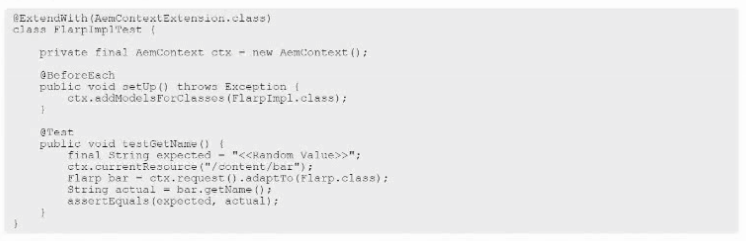
What needs to be changed for the unit test to successfully test the getName method of the Flarp Sling Model?
Correct Answer:
A
Explanation
Unit testing Sling Models requires SlingContext instead of AemContext because Sling Models need a proper resource resolver to function. SlingContext with ResourceResolverType.JCR_OAK provides the necessary JCR environment and resource resolver that Sling Models depend on. AemContext is higher level and includes AEM-specific features that aren't needed for testing the Sling Model's core logic. The correct setup ensures the getName method can properly access resolved resources during the test.
Given the following error:
[ERROR] org.acme:mybundle:0.0.1-SNAPSHOT: Bundle org.acme:mybundle:0.0.1-SNAPSHOT is exporting package
org.acme.foo without a version.
What are the appropriate troubleshooting steps for addressing this error?
Correct Answer:
C
Explanation
This bundle export error occurs when packages are exposed without version information, which creates ambiguity for imports. The solution is to check that Export-Package declarations specify versions for exported packages and that Import-Package declarations define version ranges for consumed packages. This prevents version conflicts and ensures the OSGi container can correctly wire bundles together. Without proper version specifications, the container cannot determine which bundle versions should satisfy which imports.
A developer needs to use the mode in Template Editor which allows template authors to define grid settings for different devices.
Which mode should the developer use?
Correct Answer:
A
Explanation
The Layout mode in AEM's Template Editor allows template authors to configure responsive grid settings for different device breakpoints and screen sizes. This mode is specifically designed to let authors define how the grid behaves across tablets, phones, and desktops. Other template editor modes handle different concerns like structure or initial content, but only Layout mode provides the device-specific grid configuration functionality needed for responsive designs.
A university wants to roll out content updates to all the schools affiliated with it. The individual schools have configured their respective homepages with a space allocated to display updated university information. The rest of the homepage is dedicated to school-specific information.
What is the recommended approach to roll out university updates on all the schools' homepages?
Correct Answer:
B
Explanation
When rolling out content to multiple sites that have both shared and site-specific sections, the Partial option allows you to push updates only to designated areas across all instances. This approach preserves the school-specific content on each homepage while updating the university information section consistently. Using a full rollout would overwrite everything including local content, making partial rollout the correct method for managing distributed updates across related but independent sites.
A customer added a custom property "foo:bar" to all assets. Once the property is added, the customer needs to run the following query:
select * from [dam:Asset] where isdescendantnode('/content') and [foo:bar] ="Hello"
How would the customer update the indexes to make sure the query is not a traversal query?
Correct Answer:
A
Explanation
To prevent traversal queries in Oak, custom properties must be indexed. Adding the custom property 'foo:bar' as a child node under oak:index/damAssetLucene/indexRules/dam:Asset/properties registers it in the existing asset index. This allows the query engine to use the index instead of scanning all nodes. Without indexing the property, the database must traverse the entire content tree to evaluate the where condition, which is inefficient for large repositories.
Domain 1: Configurations
24%
Configure dispatcher rules, multi-tenancy, SAML and LDAP authentication, replication agents, editable templates and content fragment models. Hands-on setup of these foundational AEM components ensures your deployment can handle enterprise requirements and secure user access.
Sample questions from this domain above:
Q3Q4
Domain 2: AEM Development
33%
Build SPAs, Sling Models, HTL components, unit tests, third-party integrations, OSGi services and servlets. Master JCR query selection for performance. This is the largest domain because component development and API integration are daily work for AEM developers.
Sample questions from this domain above:
Q1Q2
Domain 3: Build and Deployment
25%
Manage Maven dependencies, create projects with archetypes, configure custom run modes, implement workflows and Oak indexes. These skills let you automate builds, organize code for teams and optimize repository performance across environments.
Sample question from this domain above:
Q5
Domain 4: Environment Maintenance
18%
Manage AEM configurations, handle release upgrades, sync content across instances with package manager and use maintenance tools. Keeping environments stable and in sync prevents data loss and downtime in production systems.
FAQ
AD0-E137 Exam FAQ
Common questions about the exam itself
What experience level does AD0-E137 expect?
Adobe targets 1 to 3 years of hands-on AEM development experience for this expert-level exam. You need real-world exposure to building components, configuring instances and deploying to multiple environments, not just course work.
How long should I study for AD0-E137?
Most candidates prepare for 4 to 8 weeks with focused study on the four domains and hands-on labs. The depth of AEM Development and Build and Deployment means these two areas need the most practice time and scenario work.
Which domain is hardest in AD0-E137?
AEM Development at 33 percent weighting is both the largest domain and the hardest because it covers HTL templating, Sling Models, OSGi services and third-party integrations all together. These require deep Java knowledge and practical coding experience.
What is the passing score for AD0-E137?
You must score at least 32 out of 50 questions correctly to pass, which is a 64 percent pass rate. This reflects the expert difficulty of the exam.
Can I retake AD0-E137 if I fail?
Yes, you can retake the exam. After your first failure you must wait 5 days before purchasing another attempt, then 10 days for a third attempt, 15 days for a fourth, and 30 days for a fifth.
How long does AD0-E137 certification stay valid?
Your Adobe Experience Manager Sites Developer Expert certification is valid for 2 years from the date you pass. You can renew it automatically by passing two short renewal modules at no cost within the 2-year window.
What is the exam format for AD0-E137?
The exam has 50 multiple choice questions and you have 100 minutes to complete it. Questions test both theory and practical problem-solving in real-world AEM scenarios, not just definitions.
Is AD0-E137 proctored and can I take it at home?
Yes, the exam is online proctored through easyProctor. You take it from home or any private space where you can run the Process Tracker software and allow camera and microphone access for the entire exam.
What job role does AD0-E137 map to?
This certification targets Senior AEM Developers and AEM Developers who own component building, site architecture and deployment. It validates you can lead technical decisions on AEM projects for enterprise customers.
How does AD0-E137 relate to other AEM exams?
AD0-E137 is the expert-level Sites developer exam. Candidates typically start with AD0-E126 Business Practitioner or AD0-E132 Technical Foundations before moving to this expert exam to build foundational knowledge first.

